
Minerals and Energy Resources Class 10 Notes | CBSE & NCERT Boards Study Guide

Minerals and Energy Resources Class 10 Notes | CBSE & NCERT Boards Study Guide

Introduction

Minerals and energy resources form the backbone of industrial development and economic growth. This chapter is highly important for students studying in CBSE, NCERT, UP Board, Bihar Board, RBSE, MP Board, Jharkhand Board, and other Hindi Belt state boards.

Students frequently encounter board exam questions related to:

  • Distribution of minerals in India
  • Conventional and non-conventional energy resources
  • Conservation of minerals
  • Mining hazards
  • Map work
  • Case-study questions

This complete all-in-one study guide provides:

  • Easy notes
  • Question answers
  • MCQs
  • Revision strategies
  • Board preparation tips
  • SEO-optimized educational content

Chapter Overview

  • Minerals: Naturally occurring substances with definite chemical composition.
  • Energy Resources: Conventional (coal, petroleum, natural gas) and Non-conventional (solar, wind, nuclear).
  • Distribution: Minerals are unevenly distributed across India.
  • Conservation: Necessary because minerals are exhaustible resources.

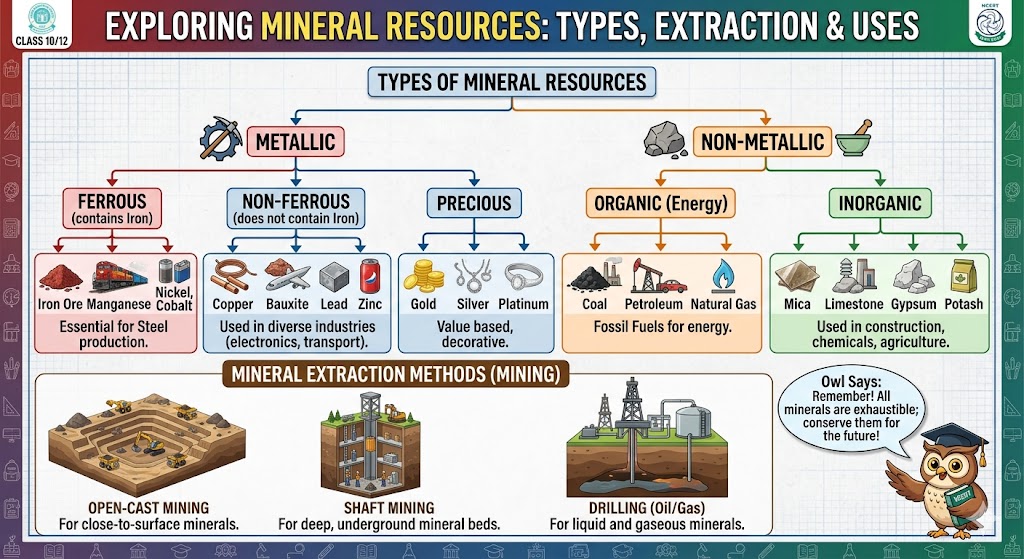
Types of Minerals

1. Metallic Minerals

Metallic minerals contain metals in raw form.

Examples:

  • Iron ore
  • Copper
  • Bauxite
  • Manganese

2. Non-Metallic Minerals

These minerals do not contain metals.

Examples:

  • Mica
  • Limestone
  • Gypsum

3. Energy Minerals

These minerals are used for producing power and energy.

Examples:

  • Coal
  • Petroleum
  • Natural Gas

Energy Resources

Conventional Energy Resources

  • Coal
  • Petroleum
  • Natural Gas
  • Electricity

These resources are widely used but are exhaustible and polluting.

Non-Conventional Energy Resources

  • Solar Energy
  • Wind Energy
  • Tidal Energy
  • Biogas
  • Nuclear Energy

These resources are renewable and eco-friendly.

Distribution of Minerals in India

MineralMajor Producing States
Iron OreOdisha, Jharkhand, Chhattisgarh, Karnataka
BauxiteOdisha, Gujarat, Jharkhand, Maharashtra
MicaJharkhand, Bihar, Andhra Pradesh
CoalJharkhand, West Bengal, Odisha
PetroleumAssam, Gujarat, Mumbai High


Distribution of minerals in India Class 10 Geography map

Importance of Minerals and Energy Resources

  • Help industrial development
  • Generate employment
  • Support transportation
  • Produce electricity
  • Essential for manufacturing industries
  • Important for economic growth

Conservation of Minerals

Minerals are exhaustible resources that take millions of years to form. Therefore, conservation is extremely important.

Methods of Conservation

  • Use minerals carefully
  • Promote recycling
  • Use alternative resources
  • Reduce wastage
  • Use renewable energy resources

Hazards of Mining

  • Land degradation
  • Deforestation
  • Water pollution
  • Air pollution
  • Health problems for workers
  • Soil erosion

Board-Wise Exam Focus

CBSE Board

  • Map-based questions
  • Competency-based questions
  • Difference between conventional and non-conventional energy resources
  • Conservation methods

UP Board & Bihar Board

  • Distribution of minerals
  • Short notes on coal and petroleum
  • Long answer writing practice

RBSE & MP Board

  • Importance of minerals
  • Industrial development questions
  • Map practice

Important Questions and Answers

Very Short Answer Questions (1 Mark)

Q1. Define mineral.

A mineral is a naturally occurring substance with definite chemical composition.

Q2. Name two non-conventional energy resources.

Solar energy and wind energy.

Short Answer Questions (3 Marks)

Q1. Differentiate between ferrous and non-ferrous minerals.

Ferrous MineralsNon-Ferrous Minerals
Contain ironDo not contain iron
Example: Iron oreExample: Copper

Q2. Why is conservation of minerals important?

Conservation is important because minerals are limited resources and cannot be replaced quickly.

Long Answer Questions (5 Marks)

Q1. Explain the distribution of iron ore in India.

Iron ore is mainly found in Odisha, Jharkhand, Chhattisgarh, and Karnataka. Odisha is the leading producer. High-grade hematite ore is found in these regions.

Q2. Discuss the importance of petroleum and its occurrence in India.

Petroleum is used as fuel and raw material for industries. Major petroleum-producing areas include Assam, Gujarat, and Mumbai High.

MCQs with Answers

1. Which state is the largest producer of bauxite?

  • (a) Gujarat
  • (b) Odisha
  • (c) Jharkhand
  • (d) Maharashtra

Answer: (b) Odisha

2. Which is the most important industrial iron ore?

  • (a) Magnetite
  • (b) Hematite
  • (c) Limonite
  • (d) Siderite

Answer: (b) Hematite

3. Which energy resource is renewable?

  • (a) Coal
  • (b) Petroleum
  • (c) Solar Energy
  • (d) Natural Gas

Answer: (c) Solar Energy

Common Mistakes Students Make

  • Confusing metallic and non-metallic minerals
  • Ignoring map practice
  • Forgetting examples
  • Writing vague answers
  • Skipping revision

Smart Revision Notes

  • Iron Ore → Odisha, Jharkhand, Chhattisgarh
  • Bauxite → Odisha (Koraput Plateau)
  • Coal → Damodar Valley
  • Petroleum → Assam, Gujarat, Mumbai High

Mnemonics & Memory Tricks

Iron Ore States:

“I Only Jump Carefully”

  • I → Iron Ore
  • O → Odisha
  • J → Jharkhand
  • C → Chhattisgarh

Bauxite States:

“Big Giant Mountain”

  • B → Bihar
  • G → Gujarat
  • M → Maharashtra

One-Day Revision Strategy

Morning

  • Read NCERT notes
  • Revise mineral types

Afternoon

  • Practice maps
  • Revise important states

Evening

  • Solve MCQs
  • Practice previous year questions

Frequently Asked Questions (FAQs)

Why is coal called the backbone of energy in India?

Coal is called the backbone of energy because it is the most abundant fossil fuel and supports thermal power generation and industries.

Which mineral is indispensable for electronics?

Mica is indispensable for the electronics industry due to its insulating properties.

What are the hazards of mining?

Mining causes land degradation, deforestation, pollution, and health problems.

Why are non-conventional energy resources important?

They are renewable, eco-friendly, and reduce environmental pollution.

Conclusion

Minerals and energy resources are essential for industrial and economic development. This chapter is highly scoring for CBSE and Hindi Belt Board students if they prepare maps, definitions, MCQs, and important questions properly.

Students should regularly revise:

  • Types of minerals
  • Distribution in India
  • Energy resources
  • Conservation methods
  • Map locations

With smart revision strategies and continuous practice, students can score excellent marks in board examinations.

Related Study Materials


Leave a Comment

Scroll to Top