
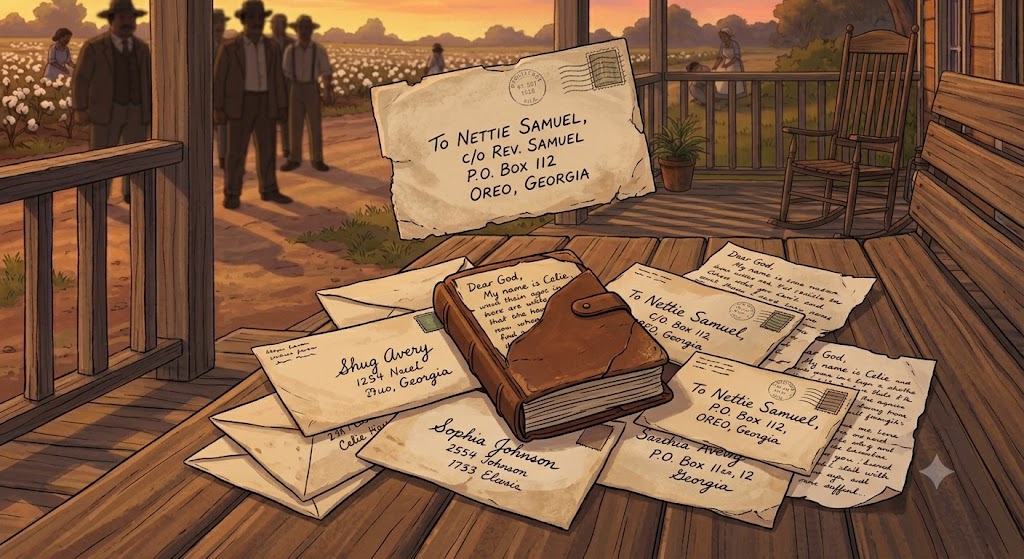
Alice Walker’s The Color Purple employs an epistolary structure and Black folk English to portray Celie’s journey from oppression to self-discovery. The novel’s narrative style enhances authenticity, emotional depth, and character development.
Black folk English in The Color Purple and Celie’s narrative voice
The narrative style and structure of The Color Purple is selected in such a manner so as to facilitate Celie’s growth into a self-possessed woman. The Black folk English is employed in order to make Celie’s language as authentic as possible, given the context of its early twentieth century period and its southern setting. The epistolary mode of the novel is employed as it is a form which is well suited to the confessional quality of Celie’s narrative and gives her a chance to articulate her story in all its detail. The Black folk English with its rural Southern inflections and the free flowing epistolary mode enables Celie to speak her mind without inhibition or fear.
Walker has had to justify her choice of the novel’s language due to ban in Oakland, California. In her essay “Coming in from the Cold” she remarked that Celie could not have been faithful to her ancestors if she spoke in the language of oppressors. Her being is revealed affirmed by the language in which she is revealed, and like everything about her it is characteristic, hard-won and authentic.
Alice Walker writing style and Epistolary novel The Color Purple
Barbara Christian sees Walker’s use of the epistolary mode as her characteristic trait of using a ‘forbidden route’ to approach the truth. Celie’s letters not only inform the readers about the oppression she bears but it is also an indicator of her growth. She tried to reproduce the dialect of her grandparents, who were from Georgia, that had cadence and amazing brevity. The epistolary mode was a natural choice since like Sojourner Truth who cried out to God when her children were sold. Celie very naturally talks to God as she has to tell somebody about what has happened to her.
The epistolary mode makes it natural for Celie to record her each and every daily ritual or experience. She records the day she tells Mr._____ she is leaving him in great detail and while writing to Nettie, she talks about everybody in her family including their life histories. The epistolary form is flexible enough to incorporate such variation in theme, as well as content.
Nettie’s Writing Skill and the use of letters
Nettie’s letters to Celie form an interesting variation of the epistolary mode. She writes in a much more refined manner than Celie does. This is perhaps because she is an educated woman who goes to Africa as a missionary. Although her worldview is a much more expansive one than Celie’s, both of them think alike about God; the difference in their languages does not distance them as sisters. Moreover, the double narration gives a depth to the text and is quite like Walker’s quilting technique that she follows in her novels. Like the creation of the patchwork quilt where components parts serve to illustrate a single theme, the narrators go to affirm certain similar themes—such as oppression, love, understanding and healing.
Conclusion
The novel progresses and Celie’s act of writing letters connects her to the people around her and finally to God; from being a woman who feels nothing she graduates to a woman who can proudly say, affirming her linguistic legacy, “Look like to me only a fool would want you to talk in a way that feel peculiar to your mind.”