
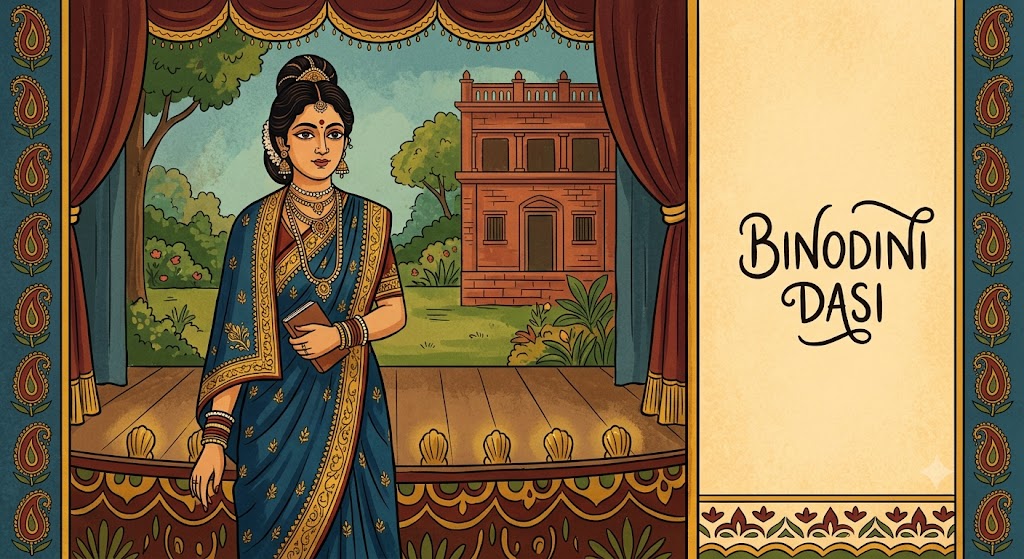
Binodini Dasi life
Binodini Dasi (1860–1941) actress and singer, was born in a suburb of Kolkata, inhabited mainly by sex-workers. Her family was poor and it is said to have been involved in prostitution. In her biography, she called herself a prostitute. She was married at the age of five, but later had no connection with her husband; instead, she had to become successively the mistress of three persons, the last one sheltering for twenty-nine years.
Binodini Dasi came to be known as the most famous actress of the 19th c. Bengal. At the age of thirteen or fourteen, in December 1874, she made her debut in the Great National Theatre in a minor role, that of Draupadi. She worked for this theatre for two years, and then briefly for the Bengal Theatre, but she settled down for a much longer period — six years — with the National Theatre, where the famous actor and playwright Girish Chandra Ghosh worked. It was from him that she really learnt the skill of acting and along with him that she founded the Star Theatre in the early 1883.
Prostitution and Poverty
Binodini Dasi, born in a red light area in the metropolis of Calcutta in a family struggling with poverty. The mere survival of them became their primary requirement. Her grandmother had a mud house in her possession or most probably a brothel. Binodini kept silent about the profession of their prostitution. The house No 145 on Cornwallis street came under the ownership of Binodini afterwards. Prostitution is a taboo subject and Binodini always used humbleness to overshadow the underlying truth. But at the same time, the erasure on truth emphasizes on the reality in a more prominent manner.
Binodini after highlighting on their household and region of her birth, steps on to discuss about her family. Her family consist of her grandmother, mother, Binodini and her brother. Binodini and her brother were born out of wedlock since her guardian’s work was that of prostitution. (No father-figure is mentioned in the autobiography which also again highlights the lines of prostitution in 19th c. Bengal.)
The major struggle of Binodini and her maternal family was poverty. In order to subside some of their problems, their grandmother married off her five-year-old brother to a ‘little motherless child of two and a half year old’. The marriage was coupled with little dowry of some jewelleries. The sale of those jewelleries helped them to run their livelihood.
Socioeconomic Struggles & Core Trauma
Similar techniques were also applied in case of her mother and grandmother’s jewelleries. Binodini was highly obsessed with a background of propriety and untainted character. Prostitution was a haunting trauma for her. She always tries to exhort on the virtues of her and family. In doing so, the society’s irrational and brutal stereotypical torture on the marginalized is exposed. Being a prostitute does not conform to the society’s convention. But the crucial problem is survival. Prostitution becomes a source of survival for these marginalized women. Often, the people who criticize these women or fallen women use them to quench their thirst. Double-facedness and hypocrisy are embedded in society’s demonic face. Binodini’s mother and grandmother only tried to survive in this horrendous society — “They gave us the food, never grieving about the jewellery they had been forced to sell”. It may sound humble but there was no other option open to them.
In order to expose the intensity of their poverty Binodini narrates about an incident: when her mother had gone to someone’s sraddha ceremony and asked for a few sandesh for her children. Binodini calls it ‘gifts of charity’ but they were already ‘ten or fifteen days old’. Obviously, the sweets became contaminated but for them, it was obvious ‘great pleasure’ to all three of them. They did not devour the sweet, instead they nibble on it fearing they ‘would be finished all too soon’.
Tragedy & The Loss of her Brother
Death of her brother: Binodini points out that poverty snatched her brother away from them at an early age. They were struggling from financial crisis and so charity hospital was only available treatment centre for them. Binodini and her sister-in-law were insured under the guardianship of a kind neighbour where they also spend their night. Binodini again projects the humble connection with a good neighbour who tremendously helped them in their great crisis. She was a person who tried to help others both physically and financially. Some days, she used to caress their ill brother, by sending Binodini’s mother and grandmother to eat. Binodini particularly highlights that their neighbour had little property but she was a selfless person. People living in red light area are categorized as ‘baseborn’, taint to society, irrespectable and improper. But they follow humanity more than that of people of aristocrat class. Binodini tried to project this aspect through her autobiography.
Binodini and her family lost their brother and this memory was vividly etched in her memory. There were three generation of daughters in their family and her brother was mostly loved one. It was a tremendous shock to the poor family. Binodini’s mother went insane after the incident. She would break into wild laughter from time to time. Her grandmother in fear of postmortem ran off with the dead body. They spent the time with the dead body for over an hour. They required permission for cremating the dead body because her brother was undergoing treatment with ‘poisonous medicine’.
Maternal Trauma & Early Marriage
Tragedy piled one upon one on them. Binodini’s mother could not handle the trauma of being separated from her only son. She ‘had gradually walked into the river till she was waist deep in the Ganga’. Binodini still a child clung tightly to the saree of her mother and screamed loudly. Her grandmother ran towards them to rescue them. The emotions did not a Binodini’s mother needed to vent out her pain and at last she burst into an uncontrollable crying of pain. Binodini was terrified to see the condition of her mother.
Binodini’s Early Marriage
Binodini came to know that she was also married to a beautiful boy slightly older than her. They used to play together. But destiny did not allow them to live together. The boy was separated from Binodini by their aunt-in-law. Sometimes, later Binodini came to know that the boy was married off to someone else and he had a family of his own. He also died leaving his family. When Binodini’s brother was alive, they had tried several times to bring her husband back but it resulted in failure. Being a prostitute, Binodini had a strong desire of a family and living her life as an honourable woman. The ‘bhadramahila’ concept was something that made her obsessed all throughout her life. The men who came in her life scrutinized it according to their needs and pleasure. Binodini was promised a lot by these men but she received nothing from them.
Binodini Dasi theatre career| Introduction of Theatre Life: / Episode of Ganga Baiji
Binodini was meant to act in theatre and so the destiny of her life took to the life of an actress. When she was nine years old, a singer came to live in their house. There was a cemented room on the ground floor and Ganga baiji was the name of the person who was given this room. This same Ganga Baiji became a famous singer at the Star Theatre. Gangamoni or Gangabaiji was a generous person who remain unaffected ‘by pride or vanity’ even as ‘she occupied high position of a singer-actress at the star’.
Binodini was apprenticed to Gangamoni in the dire need of survival. Not that she went to theatre as a choice but as a need in her life. Binodini learnt singing from Gangamoni. Visitors used to came to Gangamoni for entertainment and praised appreciated Binodini for her singing talent. Sometimes later after the death of her brother two gentlemen arrived called Babu Purnachandra Mukhopadhyay and Brajanath Seth. They noticed Binodini’s talent and suggested her grandmother to apprentice her to the stage life. ‘There were only two theatres those days: one was Sri Bhubanmohan Neogi’s National Theatre and the other the last Saratchandra Ghosh mahasoy’s Bengal Theatre’. Hence, Binodini was apprenticed to the stage at the monthly salary of ten rupees.
Mentorship under Girish Chandra Ghosh
For Binodini, Girish Chandra babu became a great instructor. He had a method of educating and explaining about the role: first he would explain to her the bhava and later instructed her to memorise the lines. Later, he would come to Binodini’s home along with Amrit Mitra, Amrit Babu and several others. He would strike on the conversation of about great English actresses and the works of famous poets Shakespeare, Byron, Milton and Pope. Binodini claims that she received special attention from her tutor and thus she commenced to learn about her role, using her ‘special intelligence and knowledge’.
Binodini mentions about her marvellous performances and how the management greatly appreciated her role. She used to feel the character deeply from within herself. She completely transformed her identity into the character she was playing. Even though the theatre faced crisis when the owners changed frequently like from Kedarnath to his brothers Haradhan and Krishnadhan to sri Shibendranath Chaudhury, but there were some excellent stage performances that left the mark.