
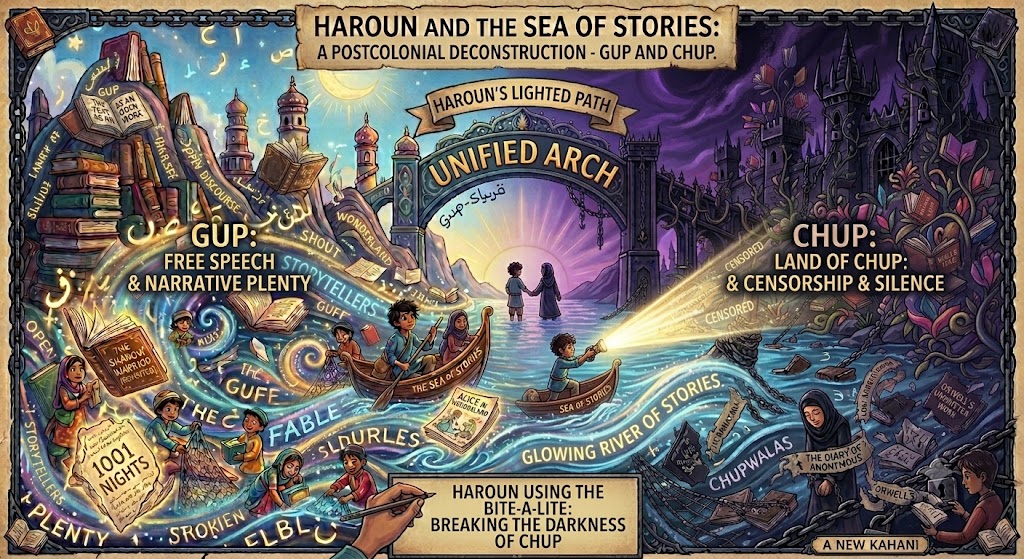
Introduction: Salman Rushdie and the Novel Context
Haroun and the sea of stories is a children book that is the fifth novel of Indian born-British American postcolonial author, Salman Rushdie. The novel, published in 1990, followed The Satanic Verses (1988).
Fatwa and the Theme of Free Speech
The significance of free speech is the crucial theme that binds the novel and it is also inspired from the “fatwa” received by Rushdie due to his work The satanic Verses. The “Fatwa” was issued by the Iranian leader Ayatollah Kohemini (Ayatollah Khomeini) who demanded the assassination for alleged disrespect of Islamic sentiment. Rushdie, in order to elevate the importance of free speech has incorporated the ‘magic realism’ style to convey his idea subtly and effectively.
Haroun’s Quest and the Question of Storytelling
“What’s the use of stories that aren’t even true?” is what Haroun hear from Mr. Sengupta, their neighbour, and Haroun’s adventure is a symbolic quest to find an answer to it. Not only the importance of free speech is projected but also the injustices and social issues are portrayed in totalitarian society. Both of these concerns are raised in the portrayal of Guppees and Chupwalas: “Gup is bright & Chup is dark. Gup is warm and Chup is freezing cold. Gup is all chattering and noise whereas Chupwalas, it is as silent as shadow. Guppees love stories and speech; whereas Chupwalas, it seems, hate these things just as strongly.” Rushdie projects a totalitarian setting in an imaginary world and how it affects and shackles the freedom of people. city of Chup corresponds to the totalitarian society of Iran and Gup city is synonymous democratic societies of West.
Khattam-Shud and Censorship of Speech
Khattam-shud, the ruler of Chup want to forcefully stop the freedom of speech. To do this, he wants to destroy “sea of stories”. The “Ocean of streams of stories” metaphorically suggest the free speech. The stories symbollic symbolically means the freedom of expression which is not acceptable in a totalitarian state. In the land of Chup, Chupwalas’ mouths have been sewn and schools, law-courts and theatres have been shut down. Chupwalas have also kidnapped Batcheat and Khattam-shud wants to sew her lips and offer her on the “Feast of Bezaban”. They wanted to make her a dumb princess and call her Princess Khamosh. “Batcheat” is a Hindi word which stands for conversation, gossip and talk, whereas “Khamosh” is a Hindi and Urdu word which stands for silence. The word “batcheat” metaphorically stands for freedom of expression and in totalitarian Chup, Khattam-shud wants to snatch this freedom and purgate the state of us presenting their viewpoints freely.
Restoration of Free Speech and Magical Symbolism
Rushdie shows the restoration of free speech when Haroun uses ‘Bite-a-Lite’ instrument gifted to him by Iff the Genie. Haroun keeps the instrument under his tongue on Khattam-shud’s dark-ship. A bright light like that of sun is poured out and it blinds the Chupwalas and they shriek and utter curses, thus breaking the vow of silence. If taken allegorically, the light breaks the darkness and light being released from the mouth is the restoration of free speech. Haroun wishes for the movement or
Resolution: Return and Power of Storytelling
rotation of Moon Kahani. Gup and Chup come under the distribution of both day and night.
Rashid and Haroun return to their own world. Rashid narrates his own incident on Moon Kahani and people identify politician Buttoo with Khattam-shud. An Buttoo is driven away, thus, demonstrating the power of storytelling and freedom of expression.