
✨ Introduction
Do you ever look up at the night sky and wonder what lies beyond? That tiny twinkling dot could be a star millions of times bigger than our Earth. Chapter 1: The Earth in the Solar System is your first exciting journey into space geography. This chapter is important for your CBSE Class 6 exams and builds the foundation for the universe in higher classes.
📖 Chapter Overview
| Topic | Key Idea |
|---|---|
| Celestial bodies | Objects in space (stars, planets, moons) |
| The Solar System | Sun + 8 planets + moons + other objects |
| The Sun | Center of Solar System; source of heat & light |
| Planets | 8 major planets (4 inner rocky, 4 outer gas giants) |
| Earth | Unique planet – air, water, life, right temperature |
| Moon | Earth’s only natural satellite |
| Asteroids & Meteoroids | Small rocky bodies |
| Constellations | Groups of stars forming patterns |
| Galaxy | Milky Way – our home galaxy |
| Universe | All of space and everything in it |
📚 Important Definitions (Exam-Focused)
Planets – Large bodies that revolve around a star; do not have their own light.
Constellation – A recognizable pattern of stars (e.g., Ursa Major or Saptarishi).
Asteroids – Small rocky objects found between Mars and Jupiter (asteroid belt).
Meteoroids – Smaller than asteroids; burn up in Earth’s atmosphere as meteors.
Galaxy – Huge collection of stars (Milky Way).
Universe – Everything that exists.
🔭 Detailed Explanation of the Chapter
1. The Night Sky – Our First View of Space
When you look up at night, most objects are celestial bodies. Some twinkle (stars), some don’t (planets).
2. The Solar System – Sun’s Family
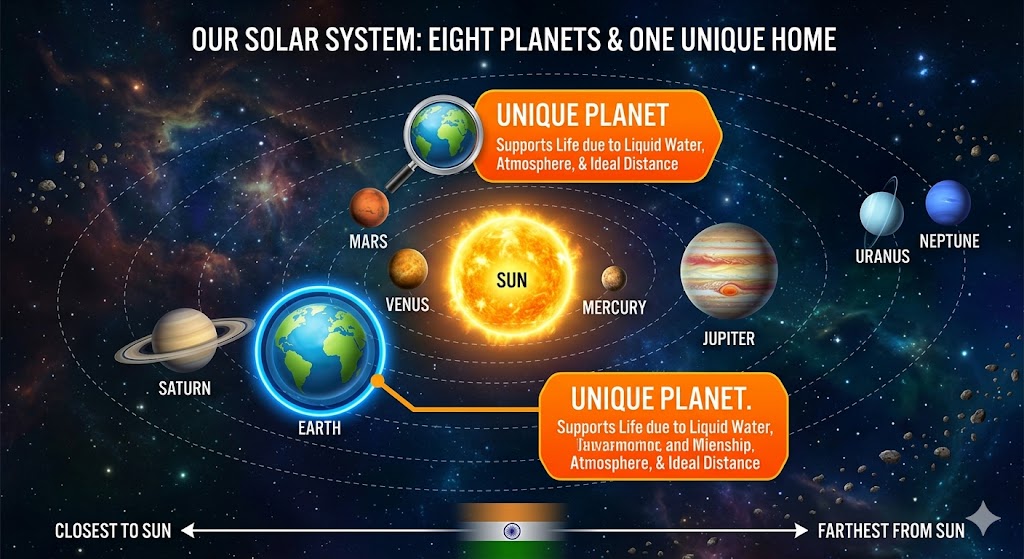
Sun is at the center (99.86% of Solar System’s mass). 8 planets revolve around it in fixed elliptical orbits.
Order from Sun: Mercury, Venus, Earth, Mars, Jupiter, Saturn, Uranus, Neptune.
3. Why Earth is Special (Unique Planet)
- Only planet with life 🌱
- Liquid water on surface 💧
- Protective atmosphere (oxygen + ozone)
- Right distance from Sun → Goldilocks Zone
- Geoid shape – slightly flattened at poles
4. The Moon – Earth’s Companion
Distance: 384,400 km. Takes 27.3 days to orbit Earth. No atmosphere → no sound, no water, extreme temperatures. Craters due to meteoroid impacts.
5. Other Members of the Solar System
Dwarf planets – Pluto (now a dwarf planet). Asteroids – Asteroid belt between Mars & Jupiter. Comets – Dirty snowballs; develop tails near Sun.
6. Stars, Constellations, and Galaxies
Pole Star (North Star) – Remains fixed; used for navigation.
Saptarishi (Big Dipper) – 7 bright stars in Ursa Major.
Milky Way – Our galaxy; contains 100–400 billion stars.
🗺️ Maps and Diagram Section (Exam Important)
- Draw the Solar System (8 planets + Sun) – label all planets.
- Show asteroid belt between Mars and Jupiter.
- Draw Ursa Major (Saptarishi) constellation.
🪐 Important Features / Characteristics of Planets
| Planet | Special Feature |
|---|---|
| Mercury | Closest to Sun; extreme temperatures |
| Venus | Hottest planet; thick CO₂ atmosphere |
| Earth | Only life; blue planet |
| Mars | Red planet; Olympus Mons (largest volcano) |
| Jupiter | Largest; Great Red Spot |
| Saturn | Most beautiful rings |
| Uranus | Rotates sideways |
| Neptune | Strongest winds |
📝 CBSE Board Exam Important Questions
Very Short Answer (1 mark)
- What is a celestial body? → Any natural object in space.
- Which planet is known as the Blue Planet? → Earth.
- What is the shape of Earth? → Geoid (oblate spheroid).
Short Answer (2–3 marks)
- Why is Earth called a unique planet?
- Distinguish between stars and planets.
Long Answer (5 marks)
- Explain the structure of the Solar System.
- Why does the Moon have craters but Earth does not?
MCQs with Answers
- Which planet has the largest number of moons? → Jupiter ✓
- The Milky Way is a — → Galaxy ✓
📌 Smart Revision Notes (One-page summary)
- Celestial bodies → Stars (self-luminous) + Planets (non-luminous)
- Solar System = Sun + 8 planets + moons + asteroids + comets
- Earth → Water, air, life, right temperature
- Moon → Natural satellite, no atmosphere
- Constellation → Pattern of stars (Saptarishi)
- Galaxy → Milky Way
🧠 Mnemonics & Memory Tricks
❓ Frequently Asked Questions (FAQs)
A. It does not clear its orbit of debris (IAU 2006 definition).
A. Venus (due to greenhouse effect).
A. A meteoroid burning in Earth’s atmosphere.
🎯 Conclusion
You have completed Class 6 Geography Chapter 1 – The Earth in the Solar System. Practice diagrams, use the mnemonic for planets, and revise the unique features of Earth. You are now ready to score full marks!
🌍 Keep exploring geography – the sky is not the limit!