
Introduction to Cilappatikaram| Who Was Ilango Adigal?
The Story of Kannaki and Kovalan
Cilappatikaram (The Tale of an Anklet) is a Tamil epic, a remarkable example of one of the earliest pieces of sangam poetry (poetry that talks about love) passed down through oral traditions. Often considered somewhat feminist, written by a Jain monk Ilango Adigal between first and third century AD, Cilappatikaram is an interesting piece of literature that makes a woman the lead of the story. More than that, she ends up defending her husband and “winning” him back in some ways. But how much feminist can we call this story?
Kannaki as the Ideal Wife
Cilappatikaram starts with the marriage of Kannaki, the noble daughter of a prince among merchants to Kovalan, an equally virtuous man. The ideals of virtue around this time, for a woman, had much to do with her “chastity”. Kannaki is portrayed as the prime “wife-material”, so to speak, literally mentioned in how “beyond all praise was Kannaki’s name renowned for making a home.”
Matavi and Female Agency
But as it so very often happens with the men in classical literature, Kovalan inevitably “falls in love with Matavi, a courtesan and under her spell” abandons Kannaki. Courtesans around this time were one of the only women to be highly educated, skilled in arts and crafts traditionally reserved for men. The use of “under her spell” however, points to the relatively similar sentiments of the public itself. She is someone who is almost “witch-like”, someone who will “steal” away the man by “bewitching” him.
Chastity as Power in Cilappatikaram
But in Cilappatikaram, Kannaki is the ideal wife. The translation would be that she has a subversive nature disguised in the form of “devotion.” Distraught, she remained “chaste and innocent”, loyal and waited for her infidel of a husband to come back.
And Kovalan does indeed come back, but only because of a misunderstanding that drives him away from Matavi. At a festival dedicated to the god Indra, they both sing of lovers, and they both assume they mean someone else. The reason why Kovalan leaves her is important; it shows the almost hypocritical belief he had and not because of his sense of duty to Kannaki.
Kannaki never gets the choice of being angry—her character must be “ideal” at all times. Embodied in her almost radical character, Matavi exerts her own agency. She keeps the memories but decides to not beg for his love.
The Symbolism of the Anklet
Kovalan returns to Kannaki, who unsurprisingly forgives him. She even moves away with him to the city of Madurai because the people who know them are angry at Kovalan for what he has done. In dire need of money, Kannaki takes off her anklets and asks him to sell them. This is a noteworthy motif because the anklet was an auspicious symbol of their marriage. The anklet changes the course of the story. Because it resembles the Queen’s stolen anklet, Kovalan is dubbed a thief and killed for it. The king is unjust, he looks for a thief only to satisfy his “nagging” wife. The relationship of married men and women share in Cilappatikaram is almost relatable. It distinctly reminds one of context: “Hunchbacks, dwarfs, mutes and maidservants clustered thickly about the queen.” Right from the beginning, the politics of class lurks behind the curtains; the significance of Kannaki and Kovalan’s family being of a certain class and how it directly relates to them being virtuous is obvious.
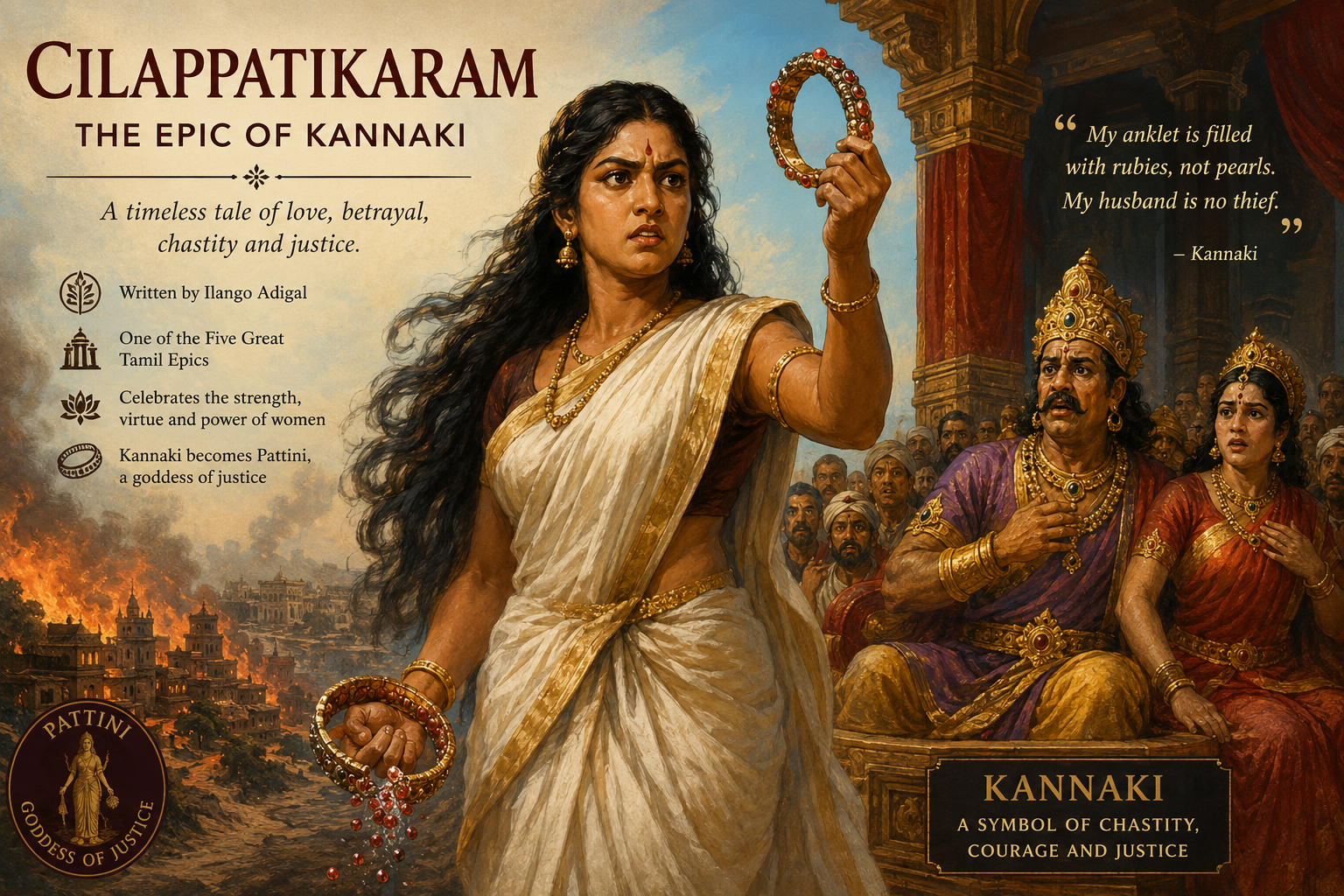
Kannaki finds out about his death when she goes to look for Kovalan; enraged, disheveled, resembling goddess Kali, she enters the palace and breaks her other anklet filled with gems (the queen’s anklet has pearls) and immediately establishes her husband’s innocence. She then goes on a rampage tearing off her breasts and sets the city ablaze. The act itself becomes a symbol. Not only has she ended her marriage by breaking her second anklet and “saved” her husband’s reputation; she ripped off her feminine features. The only people her fire spares are brahmins, good men, chaste women, cows, the young and the old.
Kannaki’s Transformation into Pattini
The gods take pity on her, she ascends to heaven on Indra’s chariot, is reunited with Kovalan, and becomes a goddess still worshipped today, ‘Pattini‘. The rest of the story follows a king who uses her identity as an excuse to start wars.
Cilappatikaram uses symbolisms liberally, flowers defining “moods” of sangam poetry amongst everything else. It is a reflection of the politics of the time as well. In fact, there is a bit about the unjust, unfair, corrupt royal family – the omens of their misfortune, however, are not very sensitive in but behind the facade of a woman “saving” her husband is an interesting dynamic of chastity as a weapon. The reason of the king’s death is an embodiment of this idea. He dies because he fails to protect a “chaste and moral” woman, he does Kannaki wrong. It is not entirely because he is guilty of corruption and has ignored his duty to the kingdom, but because he cannot protect chastity either.
Feminist Elements in Cilappatikaram
In Cilappatikaram, in her rant in front of the Queen, Kannaki mentions seven women and how they were all rewarded. A woman was told that a mound of sand on a river bank was her husband, so she didn’t move, and the river left the mound alone. Another woman was given back her husband when he was carried off by a river and she prayed to the gods—”embracing him, the golden vine of a girl returned home.” Another woman turned herself into a stone to avoid the gaze of onlookers to keep herself chaste for her husband while waiting for him to come back from the sea.Chastity is one of the reason why Kannaki was rewarded.
Structure of the Tamil Epic
The Cilappatikaram is a poem that consists in the original Tamil of 5,730 lines, composed in the akaval meter probably in the fifth century CE. This meter is also called the asiriyam, “the master’s meter”, and is the predominant meter of the epic poetry. Each line has four feet, except the penultimate one which has only three feet. The shortened penultimate line indicates the approaching end of a canto. Two other meters are also used in the poem: the kali and the venpa. There are a few passages of prose; one of them runs to fifty-six lines. They are the earliest example of prose in Tamil literature.
The poem is divided into 3 books (Kantam), and each book is divided into cantos (Katais). The books are named after the capitals of the three Tamil kingdoms (the Chola, Pandya, and Chera) that constitute the poem’s setting:
- “The Book of Pukar” comprises nine cantos;
- “The Book of Madurai”, eleven cantos;
- and “The Book of Vanci”, five cantos.
The cantos range in length from 53 to 272 lines. In addition to the cantos, there are five song cycles that function as a chorus to comment on the events of the narrative:
- “The Love Songs of the Seaside Grove”
- “The Song and Dance of the Hunters”
- “The Round Dance of the Herd’s Women”
- “The Round Dance of the Hill Dwellers”
- “The Benediction”
The song cycles follow the conventions of classical Tamil poetry.
The three books represent the 3 distinctive phases through which the narrative moves – the erotic, the mythic and the heroic. The erotic (akam) and the heroic (puram) are the traditional categories of Tamil discourse. The poet enlarges and deepens its resonance by adding a mythic (puranam) dimensions to it. Love in all its aspects is explored in The Book of Pukar using its conventional Tamil erotic poetry. The Book of Madurai retells the myth of Kannaki’s apotheosis into the goddess Pattini. The heroic aspects of kingship are the subject matter of The Book of Vanci. Here, again the poet follows the conventions of Tamil heroic poetry. Kannaki’s exemplary life as a chaste woman impacts on all the three phases of narrative and makes it structurally coherent.
Cilappatikaram and Other World Epics|Literary Significance of Cilappatikaram
The Cilappatikaram shares fewer epic features with its Indo-European cousins, the Mahabharata (400 B.C.E.−400 C.E.) and the Iliad (725−675 B.C.E.). In the Sanskrit and Greek epics, the action is centered around events in the courts of kings and culminates in a great war. The action in the Tamil epic is focussed on events in the life of two ordinary people from the influential merchant class that rose to prominence in the centuries following the end of the Mauryan empire, events that ultimately bring the protagonists into conflict with the Pandya king. War, therefore, is not central to the Tamil epic as it is to the Sanskrit and Greek. This is understandable. Given its Jaina bias, the Tamil epic is informed throughout by the idea of nonviolence, as the nun Kavunti never fails to emphasize. The Mahabharata and the Iliad, on the other hand, revel in violence.
An explanation can perhaps be sought in the historical experience of the peoples themselves: the Indo-Europeans were nomadic herdspeople, whereas the Dravidians were tillers and settled in their way of life.
In the Mahabharata and the Iliad, the protagonists Yudhishthira and Achilles are male, the protagonist Kannaki, in the Cilappatikaram, is a female. This feature alone is significant enough for us to propose that the Cilappatikaram stands in a subversive relationship to the Mahabharata. By making a woman the protagonist, Ilanko rewrites the epic tradition by subverting its essentially androcentric bias. He displaces the semi-divine warrior and the heroic ethos that surrounds him, with a mortal woman who is transformed into a divinity. Ilanko’s work is unmistakably revisionary. It does not imitate the Sanskrit epic, prestigious though that is. It builds upon forms indigenous to Tamil, which it perfects. As a female protagonist, Kannaki disrupts the epic structure and calls its presuppositions into question: in her grief, she becomes a woman out of of control and therefore dangerous. Viewed in the light, “The Book of Vanci”, is probably an elaborate rite of propitiation to appease the wrath of Kannaki and to invoke her blessing as the goddess Pattini. By foregrounding Kannaki, rather than any one of the three Tamil kings as would be normal in an epic, Ilanko shows his preference for the mythic and to a lesser extent the erotic over the heroic aspects of the poem.
The hero in the Indo-European epic is usually semi-divine. Yudhishthira’s father is Dharma, the god of justice, and his mother Kunti is a Yadava prince. Achilles’ mother is the nereid Thetis, and his father is Peleus, king of Thessaly. In the Tamil epic, the protagonist is invariably human. Kannaki is born into a noble merchant family of Pukar, but changes into a goddess in the course of epic. The Cilappatikaram, therefore, represents a bold departure from the epic tradition as we understand it. While society in the Mahabharata is organized on the basis of caste (varna), the Cilappatikaram represents a pattern of social organization indigenous to the Tamils. The organization follows the traditional division of the Tamil country into five regions (hill, forest, farmland, seashore and wasteland) and the occupations of the people associated with them.
In spite of these obvious differences, there are however some resemblances between the Cilappatikaram and other epics. The function of the epic was originally, as Albert Lord reminds us, magical and ritual. It was performed to ward off evil. Only when the function became obscured or was forgotten, did the epic come to be looked upon as entertainment. Both the Mahabharata and Ramayana are revered as sacred poetry even today. The Mahabharata has its ritual underpinning: it is considered the fifth Veda. The Ramayana is recited as incantation and ritual and performed as entertainment on the festival of Rama. The hexameter in Iliad once had, as Jan de Vries points out, an apotropaic effect. The meter was the vehicle of Apollo’s oracle in Delphi. The apotheosis of Kannaki into goddess confirms the sacred character of Cilappatikaram.
The Indian texts / epics are sacred texts exemplifying and promoting the four great ends of humans – duty, wealth, desire and liberation – through the characters as they evolve in the course of the story. The poet, protagonist and audience participate equally in the regeneration of the human spirit. The poet is never primarily an entertainer, but essentially a guide who offers enlightenment beyond the local, social and political knowledge. The vision ultimately shapes the generic characteristics recognizable in every epic poem. The epic attempts to narrate this regeneration dramatically in terms of a sequence of onset, conflict, reversal and denouement. Events are carefully selected as emblems of spiritual dilemmas. The action is circular in that the protagonists find their way back to themselves after a series of humiliations and ascend to an enlightenment beyond time.
We do not know if the Iliad at any time a sacred text for the Greeks. Simone Weil eloquently reminds us that it is only in the Gospels, and not so much in the Iliad or Attic tragedy, that the Greek genius “makes itself felt”… by the fact of commanding us to seek to the exclusion of every other good “the kingdom of God and his righteousness.” Only for one triumphant moment does the Iliad veers toward the supreme grace of the Gospels: the love of one’s enemies that overcomes the fury to avenge the death of a son, or of a friend.
Conclusion
Cilappatikaram is one of the greatest masterpieces of Tamil literature, combining elements of love, justice, morality, and heroism. Through the character of Kannaki, Ilango Adigal presents a powerful portrayal of a woman whose unwavering devotion and sense of justice transform her into a divine figure. The epic not only reflects the social, cultural, and political values of ancient Tamil society but also raises important questions about gender, chastity, power, and righteousness. Its unique focus on a female protagonist, rich symbolism, and blend of the erotic, mythic, and heroic make it distinct from other classical epics. Even today, Cilappatikaram remains relevant for its exploration of human emotions, social justice, and the enduring strength of moral integrity.