
The Role of Inquisition in Life of Galileo by Bertolt Brecht | Critical Analysis
or
Science vs Religion In Life of Galileo
Introduction
In this essay type answer, we will explore the role of inquisition in putting its considerable effort to prove wrong what is actually correct. Galileo, through his proof of heliocentric system of universe challenges the age-old belief of earth at the centre. The church for a long time preached geocentric theory as it complied with the teachings of Bible and Christainity. However, in a era where technology didn’t exist, it became terribly difficult for Galileo to prove his claim.
Man is the crown of creation, every child knows that, he’s God’s highest and most beloved creature. Would God have put his most marvelous work, his supreme effort on a little far away star that’s constantly on the move? Would he have sent his son to such a place. … Clarus: He’s right … Galileo: It has prevailed. Not I, reason has prevailed! (Act 6)
-The Very Old Cardinal:
Life of Galileo is the only history play of Bertolt Brecht which is based directly on a historical figure. Published in the year , it deals with the dominant conflict of Galileo with the Papacy. The topic of interest in the play is the clash of ideologies, with Galileo as the champion of a new spirit of empiricism and untrammelled scientific inquiry and the Church as the defender of the faith. The Church subscribed to the scholastic or Aristotelian view of the world and to the Ptolemaic system, both of which served to reconcile the biblical and the visible universe.
Galileo as a Champion of Scientific Inquiry|The Role of Inquisition as the Representative of Religious Authority|Conflict Between Science and Religion
Galileo Galilei, an Italian natural philosopher and astronomer, renowned for his remarkable contributions to motion, astronomy and development of the scientific method. In the play, Galileo is presented as a
“professor of mathematics at university of Padua, and director of the great arsenal at Venice.” He with the aid of his telescope “discovers celestial phenomena which proves the Copernican system.” “For three years in Pisa” and “seventeen years in Padua” Galileo taught hundreds of students the Ptolemaic system which was “advocated by the church and confirmed by the scriptures on which the church was grounded”. Galileo after getting the proofs of his discoveries shows his bent to let them become public.
The Fear Created by the Inquisition
Sagredo’s Warning to Galileo
Sagredo, his friend warns Galileo for showing such enthusiasm. He fears the tortuous system employed by the Inquisition and church authority for such heretical theories.
The Fate of Giordano Bruno|Suppression of Dissenting Voices
He refers to Giordano Bruno, an Italian philosopher and mathematician, who was excommunicated and burned at the stake in 1600. Sagredo’s words become highly important which shows the fear instilled among common mass who went against the authority of organized religion when he says,
“A moment ago when I saw you at your tube looking at the new stars… I saw you on a flaming pyre… I smelted burnt flesh.” (Act II)
The Inquisitor’s Opposition to Scientific Doubt
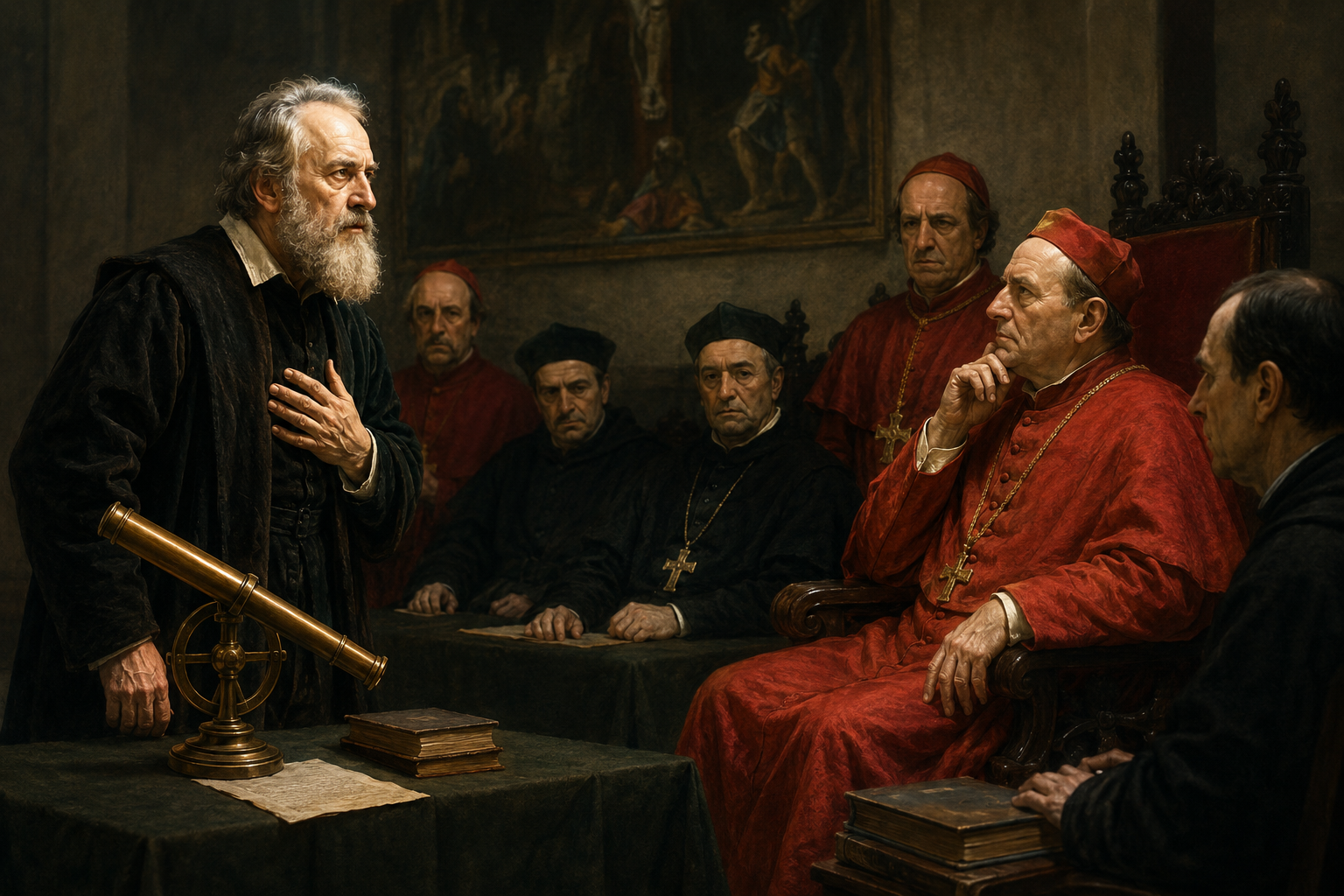
The Inquisition plays a significant role as the representative of organized religion. It plays the role of an omnipresent looker in the play, a kind of religious police force first founded in mediaeval times to investigate charges of witchcraft and reestablished in Galileo’s days to protect against the rise of Protestantism. The Inquisition had extensive power in the church and could bring people to trial and punish them at will. Aristotelian beliefs and the religious doctrine were compliant to each other which promoted that all the heavenly bodies along with sun revolved around the Earth. Copernican or heliocentric model went against this geocentric model and the challenging to the established norms and theories were considered as heresy. In matters like this, Inquisition would be very much involved in. The Inquisitor shows his contempt for doubt generated by science. He shows strong condemnation when he discourses on his thoughts,
Pope Urban VIII and the Trial of Galileo
“Everyone knows they come from doubt. These people doubt everything. Is our human community to be built on doubt and no longer on faith.” (Act 12)
Barberini, Pope Urban VIII, earlier an amateur scientist who was well disposed towards Galileo, later agrees with the Inquisitor that Galileo needed to recant his theories as heretical. The Inquisitor believes that, Galileo will recant when “the instruments may be shown to him.”
Galileo’s Recantation and Its Consequences
The Christian Inquisition felt that Galileo’s claim is a painful insult to the stronghold of Christian dogma. Since, a thousand years those religious faith fanatics had been drugged by the opium of religion, they were blinded by faith. For them faith is and ought to be sovereign in each and every moment. Thus, arose a controversy between science and religion, between rational doubt and religious faith.
The Inquisition as a Symbol of Fascism and Totalitarianism|Brecht’s Critique of Institutional Power
The role of Inquisition and its neverending power have similarities with the fascism in Italy and Nazism in Germany. It specifically refers to the ascension of Hitler to the chancellorship of Germany just prior to World War II as well as the coming of power of fascist leaders in Italy & Japan with Hitler’s rise in the ability to speak out against the government became increasingly difficult, indeed illegal.
Conclusion
However, after the recantation, Galileo continued to work on his work ‘Discorsi’. He felt humiliated for not being heroic at the moment of defending his truth. Galileo didn’t want believed that science cannot be associated with the name of one scientist only. Science is the grand project to which every discipline of science must make contributions. The failure of one scientist does not mean the failure of science.
FAQ
What is the role of the Inquisition in Life of Galileo?
The Inquisition represents the Church’s authority and acts as the primary force opposing Galileo’s scientific discoveries and promotion of the Copernican theory.
Why does the Inquisition oppose Galileo?
The Inquisition opposes Galileo because his heliocentric theory challenges traditional Church teachings and threatens established religious beliefs.
How does Brecht portray the conflict between science and religion?
Brecht presents science as a force of reason and inquiry, while organized religion is shown as defending authority and tradition against change.
Why does Galileo recant his views?
Galileo recants under the threat of torture and punishment from the Inquisition, demonstrating the immense power of religious institutions.
What is the central theme of Life of Galileo?
The play explores the conflict between scientific truth and institutional authority, as well as the social responsibility of scientists.