
Postmodern Fusion of Culture, Language, and Storytelling
In Haroun and the sea of Stories, Rushdie fuses a mixture of pop-culture, literary references, Indo-Pakistani culturalisms, and imaginary people and places with a purpose of not only expressing profound social, political and religious ideas but also of emphasizing the importance of stories and storytelling in people’s lives. Since, both modern and other old fashioned, Eastern and Western cultural traits intertwined, one can understand Rushdie’s true postmodern approach to his work. As Thomas Kullman writes, “Rushdie as a postmodern author arranges an ironical survey of various seemingly incompatible traditions and provides an insight into the working of language and text, fictional and other voice.” The simultaneous existence of both mundane and fantastical elements, where each is accepted as conventional by both readers and characters within the work, places ‘magic realism’ under the literary category of postmodernism. Often, the use of fiction is to serve both allegorical and moral purposes, and Rushdie’s implementation of this postmodern criteria is no exception.
Metafiction and Self-Reflexivity in Haroun and the Sea of Stories
Another postmodern trait generally applied to Haroun and the sea of stories is ‘metafiction’. Margaret Mackey defines the term as “A fiction about making fiction”, that is to say, a fictional work that is related to centered around the creation of fictional works. From these viewpoints, it is obvious that this piece is a work of metafiction. Right from the very
Narrative Dependence on Storytelling
beginning, the characters are shown suspended in a state that depends on storytelling, not only for the continuation of the town’s people’s business plot, but for the continuation of the town’s p— their occasional happiness, which is exactly what propels the main plot in the first place. Everything about the novel is focused on fictional narratives, from the stories that Rashid tells all the way to the army aptly referred to as the ‘library’ that is made up of ‘Pages… organized into chapters and volumes’. Another recurring theme in the novel is the question ‘What’s the use of stories that aren’t even true?’, which obviously questions the entire point of storytelling and asks the readers to consider the usefulness of such tales in real life. Rosalia Baena argues that Rushdie’s creation of fiction “illustrates and comments on such contemporary cultural issues as double-identity, life as a story and the boundaries of fiction.”
Intertextuality and Postmodern Cultural Blending
The work is intertextual, a characteristic of postmodernism in that it responds to his previous work The satanic Verses because of which he received the Fatwa and various other works of literature. The Postmodern blending of Eastern and Western culturalisms can be found in Rushdie’s references and allusions to well known works of literature, allowing the reader to make connections with stories transmitting similar messages and themes. In fact the title of the novel makes references to different collections
Literary Allusions and Cultural References
of stories— The Arabian Nights and the Kathasaritsagar, ‘Ocean of the stream of stories’. Other literary works referred to are: Gogol, Rapunzel, Kafka, Wizard of Oz.
Postmodern Features, Irony, and Narrative Theory
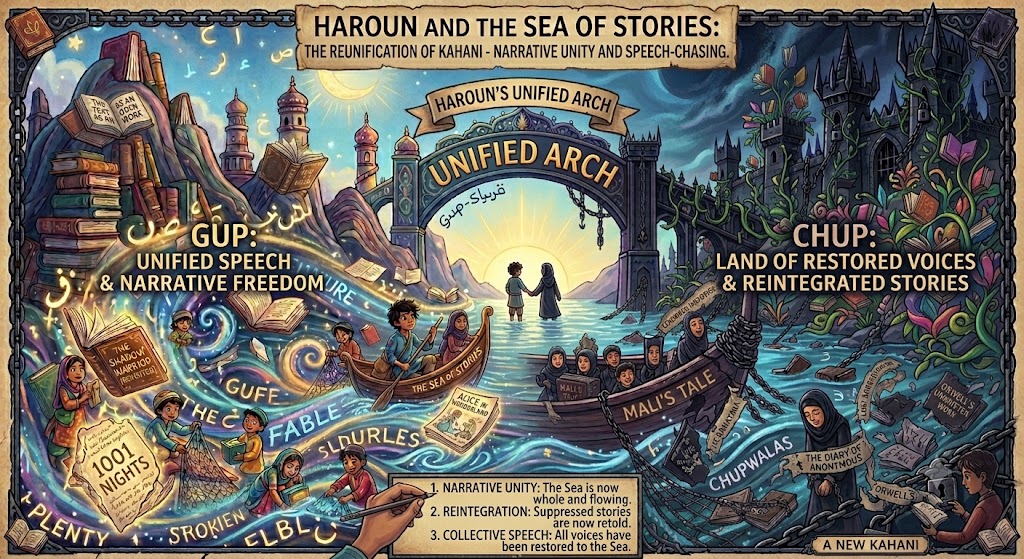
Among the other Postmodern features that can be sig singled out in Haroun and the sea of stories are sarcasm, interconnection between humour and earnestness and an array between high and popular cultures. By integrating the real with the surreal, Rushdie forces us to think what history means in its multitude of forms. The concept of the Ocean of the stream of stories is a visualization of Barthes’ authorless postmodern text, “A multidimensional space in which a variety of writings, none of them original, blend and clash… a tissue of quotations, drawn from the innumerable centres of culture.” In Rushdie’s vision of an abundance of small stories, all in opposition to the grand mythology promoted by Khattam-Shud, there is an echo of Lyotard’s famous distinction between metanarrative and petits récits. Khattam-Shud’s is the totalized account of experience that must suppress difference to maintain the illusion of its own totality; the story sea, in accordance with postmodern embrace of randomness, is a net of diverse narratives that resist (crossed out text: the choice) between assimilation & incorporation.