
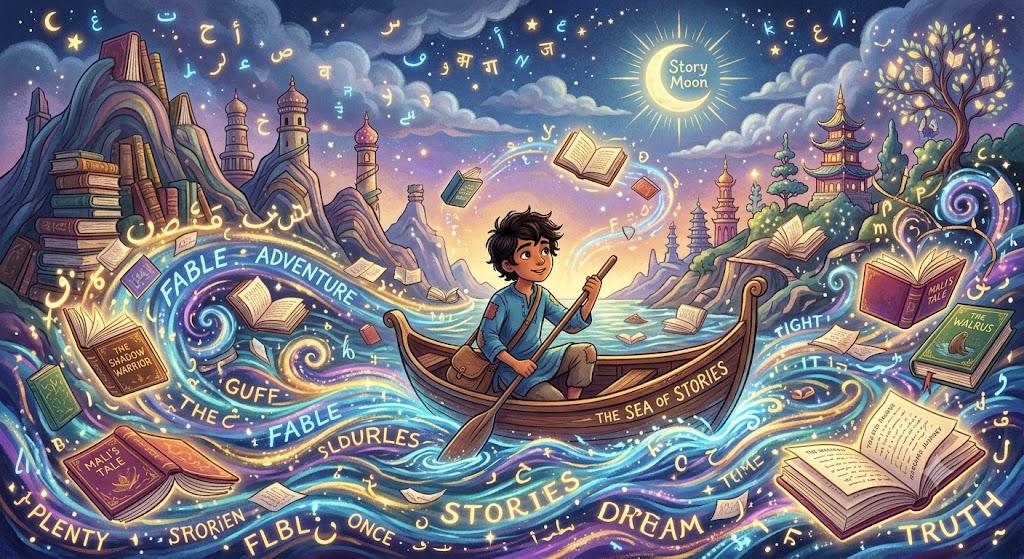
Ambivalent Status of the Text
Although written and marketed as a book for children, it falls within that category described by Zohar Shavit as text with an ‘ambivalent status’ that is a text written for both adults and children. These books’ multilayered structure is richer than even most ambivalent text: presented as an unthreatening children’ book, its politically potent subtext is easily overlooked. The metaphorical structuring of the attack on censorship coupled with the ambivalent status of the target readers behind the censor’s back is remarkable.
Language and Style in Children’s Literature
Clearly, the language in Haroun and the sea of stories is more indicative of a juvenile readership than an adult readership. Although Peter Hunt notes that any definition or classification of children’s literature is condemned from the outset to oversimplification and overgeneralization, he provides us with a useful list of typical characteristics of the language and style of children’ literature. These can be summarized as follows: child-orientedness, simplicity, easy-structure, a narrow range of grammatical and lexical pattern, standard set phrases, words from everyday life, repetitions and short sentences. Other traits which are considered typical of children’-literature are dialogue and incident are more prevalent than description or thoughts; the concrete is privileged over the abstract; the indeterminate or the ambiguous; the pace of the plot is fast rather than slow; and movement and action prevail over,
Narrative Techniques and Child-Oriented Structure
stasis, inaction or reflection. Haroun and the sea of stories respects these norms both at the primary level of plot, and at various sublevels as a dream or as reflection, employing a child-like range of lexis and grammatical structures, especially in the narrator’s and the main protagonist’s voice. In terms of the use of standard set phrases and idioms rather than experimental language, Haroun and the sea of stories operates on both levels: the simplicity of register (registering) and lexis is belied (crossed out text: failed to give a true impression) by the originality and creativity in the plot and by a varied range of speech patterns employed by the members of the caste. The language is fertile, vivid, alive and new words appear as the characters make them up. It is eternally playful, appealing to children directly and to adults for its multi-layering manifests in that very playfulness, also through the pregnant allusions in names and place-names. The nonsensical element in language, content and the continuous reference to ‘Gup/nonsense’ also upholds the children’ book ambience in the tradition of Alice and Lear.
Themes and Motifs in Children’s Literature
Some other children’ literature motives and traits at the level of content would be lack of historical detail or context (timeless setting); lack of technical or specific details; and optimistic rather than depressive outlook; certainty rather than probability; the prevalence of magic-fantasy; simplicity-adventure; themes such as childhood, friendship, familial relationships, maturation processes; avoidance of theme such as death, violence, sex, horror, disease, war, controversial sexual norms, alcohol and,
Conclusion: Dual Readership and Literary Technique
swear words. All of these apply to Haroun and the sea of stories. Like Carroll and Swift, Rushdie resorts to irony, allusion, metaphor, intertextuality and hidden adult subtexts to create successfully this double target. Thus, both at the level of subtext content as well as that of style, Haroun and the sea of stories is a successful children’ book that caters to adult readership.