
Postcolonial Framework and Critical Interpretation
The postcolonial critic Homi Bhabha argues that “Salman Rushdie’s The Satanic Verses attempts to redefine the boundaries of the Western nation, so that the ‘foreignness of languages’ becomes the inescapable cultural condition for the enunciation of the mother tongue.” Strikingly, this description would fit Haroun and the sea of stories as well since it also deals with issues of cultural and political confrontation, of boundaries and languages, of exclusion and identity, of interpretation and (re)definition. Haroun and the sea of stories, generally considered a minor work, offers a postcolonial analysis that sheds light on those elements of the novel which are often glossed over in the allegorical interpretation.
Subversion and Postcolonial Theory
The postcolonial critics Ashcroft, Griffiths, and Tiffin make the claim that ‘A characteristic of dominated literatures is an inevitable tendency towards subversion.’ Consequently, it can be argued that, in a postcolonial light, Haroun and the sea of stories exposes the physical and psychological damage caused by the tyranny of colonialism and imperialism. This is very much in keeping with Rushdie’s other novels and essays, in which he writes from the perspective of the ex-colonies in dialogue with the ex-colonizer. His often-cited phrase ‘The Empire Writes Back’ is fully applicable to what takes place in Haroun and the sea of stories. Thus, following up the subversive elements and reversals of the narrative is likely to yield interesting insights.
subversion: the undermining of the power & authority of an established system or institution.
Binary Oppositions and Colonial Geography
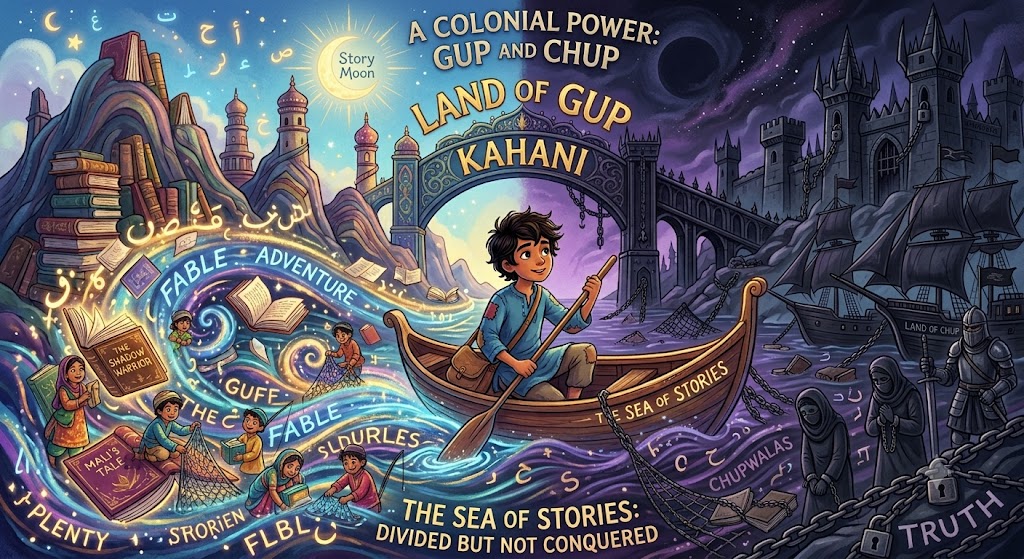
The binary oppositions that structure the seemingly allegorical story are deconstructed in the narrative. They are also subverted by the protagonist’s views and actions. To begin with, the ‘geography’ of the Moon Kahani and its distribution of light and darkness suggest a colonial conflict rather than a simple opposition between the freedom of speech and censorship, as the main geographical divide on the moon is not between East and West, but between North and South. The sunlit land of Gup is in the North of Kahani, whereas the perpetually dark Chup is in the south. Correspondingly, the inhabitants of the North are characterized as good and their enemies as evil and threatening. It is impossible for the readers not to think of his other—own of the work, with its to historical divide between the light-skinned colonizers from the North (Europe) and the South (the Indian subcontinent, Africa etc). In keeping with their ‘civilizing mission’, the ‘enlightened colonial societies’ were bent on eradicating the savage customs, Pagan religions and ignorance of the dark people.
Colonial Exploitation and Ideological Control
This mission provided the ideological framework for the colonizers to appropriate and exploit the world’s resources for their own benefit. That is what exactly happens in Kahani, to the ‘Egg-heads of inventing a way to stop the rotation of their planet’, which allows them to appropriate daylight, a most vital resource, from the Chupwalas. As Abdul Jan Mohammad explains, “the colonial mentality is dominated by a Manichean allegory of white and black, good and evil, salvation and damnation, civilization and savagery, superiority and inferiority, intelligence and emotion, self and other, subject and object.”
Manicheanism – syncretistic religious dualism.
Orientalism and Representation of the “Other”
Edward Said also remarks “the emblematic ‘blacks’ ugliness, idleness, rebellion are doomed forever to subhuman status,” (Culture and Imperialism). Taken together these allusions in the novel show that the two sides of Kahani are reminiscent of Britain and its colonies.
Subversion of Colonial Duality in Narrative
Rushdie’s narrative clearly subverts the duality. The author systematically questions the legitimacy of Guppees’ values. The colonizers are satirized in various ways. Their parliament is called Chattowbox, pointing to the excessive production of discourse as the power centre of democracy. The glossary informs the readers that Gup means gossip, nonsense and fib. This information leads one to believe that Guppualas talks are not to be trusted. The author also ridicules the romance between Guppee prince Bolo and his Beloved the kidnapped Batcheat. This is a subversion of the ideal beauty of the western woman (crossed out text: im) imposed on the colonized. A further subversive colonial reference in Haroun and the sea of stories involves the description of the Guppee army in battle.
Language, Power, and Colonial Discourse
The first use of language in the Gup-Chup conflict is also indication of a colonial (crossed out text: subject) subtext. Not only has the Guppee side stolen light, they also have appropriated speech and the definition of what is meaningful. The Gup chit-chat
Silence and Resistance in the Colonial Other
in the novel about the dark side can be seen as obliquely reluctant to their repressed guilt over stealing the sun from Chup. In contrast, the dark other is silent—arguably only to the ears of the colonizer.