
Refract means bending. The bending of ray of light when it pass from one medium to another medium is known by a term called refraction.

Refraction of Light happens due to different speed of light in different medium. Speed of light in air is 3×10⁸m/s and that of in glass is 2×10⁸m/s.
Refraction of Light:</span > It can be defined as the change in the direction of light when it passes from one medium to another medium obliquely.
A transparent substance in which light can travel is called a medium. For example Air, water, glass, kerosene etc are the transparent substances in which light can travel.
Refract means bending. The bending of ray of light when it pass from one medium to another medium is known by a term called refraction.
Refraction of Light happens due to different speed of light in different medium. Speed of light in air is 3×10⁸m/s and that of in glass is 2×10⁸m/s.
Refraction of Light:</span > It can be defined as the change in the direction of light when it passes from one medium to another medium obliquely.
A transparent substance in which light can travel is called a medium. For example Air, water, glass, kerosene etc are the transparent substances in which light can travel.
Causes Of Refraction of Light
Cause of Refraction : The speed of the light in different transparent substances is different. For example speed of light in air is 3×10⁸ m/s and that of in glass is 2×10⁸ m/s. It is clear that the two speeds of the light are different. When light enters from air to glass the speed of the light gets decreased at the junction of the two media. This change in speed of the light affects the speed the of the various segments of the beam of the light. This can be concluded by the image. This change in speed of the light causes refraction.

Therefore the refraction of light is due to the change in the speed of light on going from one medium to another.
Now it is good question why change in speed causes refraction. Here is the answer. If we look the image carefully. The left part of the beam of light enters first into another medium while its right part remains still in first medium here air. Therefore the speed of the left part of the beam experiences speed reduction before that of the right part of the beam. This causes less distance covered by left side beam and more distance traveled by right side beam.
Dear friend if you have any doubt , then comment please. Or you can give your suggestion about this part of the refraction of light.
Three Cases of Refraction of Light

Case1: </span >When ray of light travels from rarer medium like air to a denser medium like glass then it bends towards normal.
Case 2: </span > When ray of light travels from denser medium like glass to a rarer medium like air then it bends away from the normal.
Case 3: </span > When ray of light travels from rarer medium like air to a denser medium like glass and again emerges to the previous rarer medium then it suffers a la
teral displacement as shown in the figure.

Effects of Refraction of Light
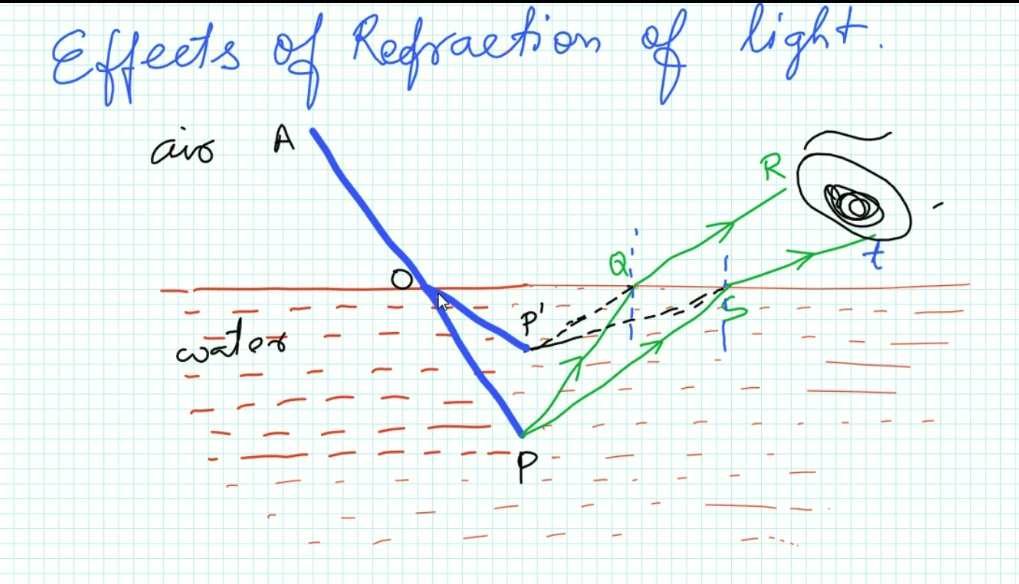
There are many effects of the refraction of life in our day to day life. For example I am citing few of them.
a) The partly immersed stick appear to be bend at the surface of the water.
b) The coin kept in water appears raised upward.
c)The water of a pool appear less depth.
d)Stars appear to twinkle in the sky when the sky remains clear.
e)A lemon immersed in water appears to be bigger in size.
All these are discussed in the above video. If you have any confusion then comment below.
Law of Refraction Of Light
There are two laws of refraction of light. these are :
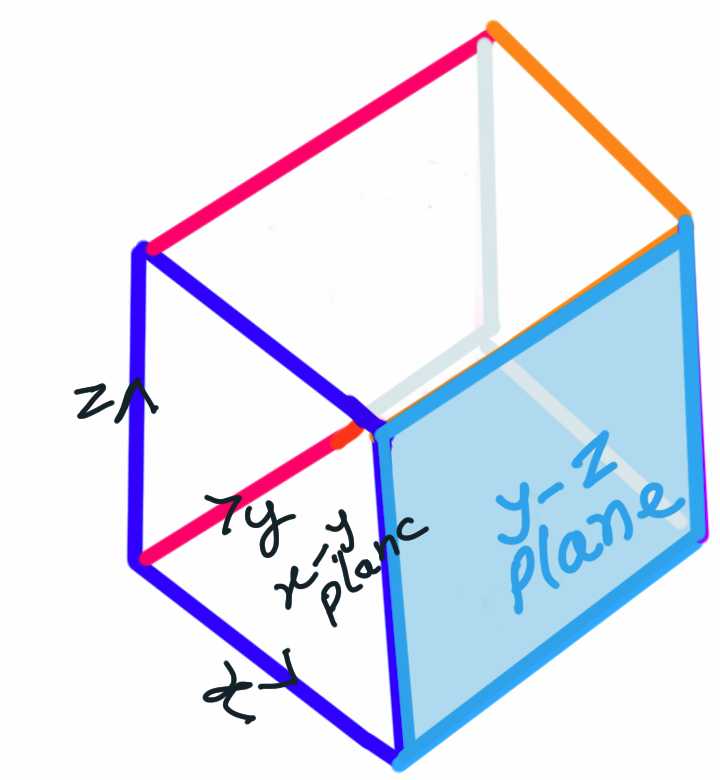
a) Incident say , refracted ray and normal lie on same plane .
The concept of plane is shown in the image. In terms of x,y and z co-ordinate system , the y-z plane is shown in light sky blue colour.
We write on our copy which is considered x-y plane. The image is given just for understanding of plane concept. It is not needed while writing the law. Try to image other planes in the image.
b) Ratio of sin of angle of incidence and sine of angle of refraction remains constant for a pair of media. i.e.
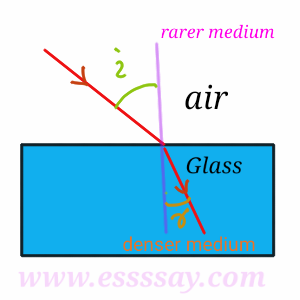
sin i / sin r = constant (n)
this constant is called refractive index of medium 2 with respect to medium 1.
or we can write
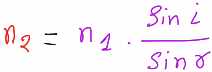
n2 / n 1 = sin i / sin r
Where n 1 is the refractive index of first medium here air. And n2 is the refractive index of second medium here glass.
∴ n2 = n1 x ( sin i / sin r )
If you have any query regarding the laws of refraction then comment below.
Refreactive Indext of Light From Medium 1 to Medium 2 and Vice Versa Relation
Refractive Index of Medium 1 to Medium 2 :
Refractive index for ray of light going from medium 1 to medium 2 is equal to the reciprocal of the refractive index for ray of light going from medium 2 to medium 1.
This can be proved in following way:
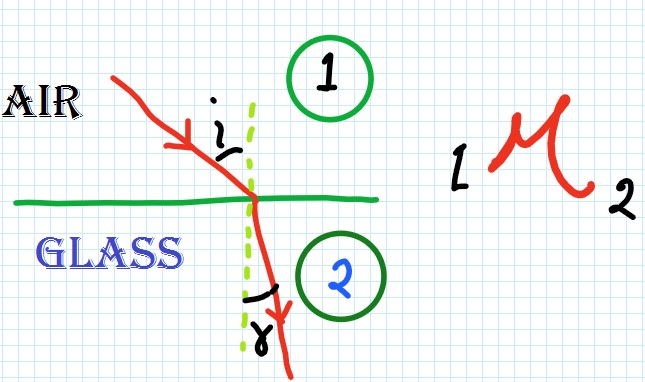
Suppose in first case ray of light is travelling from air to glass. Here air is taken as medium 1 and glass is taken as medium 2.
Let velocity of ray of light in air is v1
and that of glass is v2
we also know 1μ2 = v1 / v2
In this case we can write
Refractive Index (R.I.) of medium 2 = v1 / v2 – – – – – – – – – 1
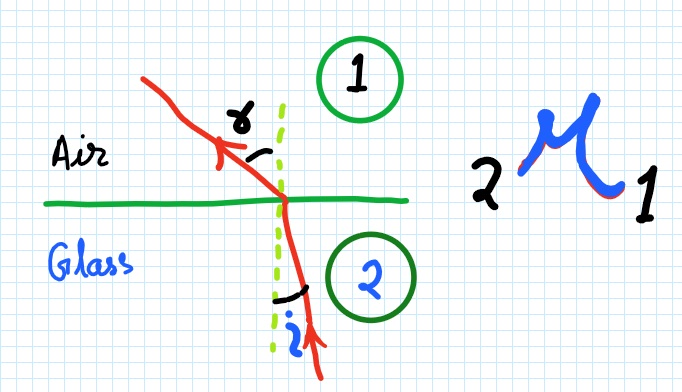
Again suppose in second case light is travelling from medium 2 to medium 1 . Refractive Index (R.I.) of medium 1
= v2 / v1 – – – – – – – – – 2
I am again writing the equation 1
Refractive Index (R.I.) of medium 2 = v1 / v2
or Refractive Index (R.I.) of medium 2 = 1 / (v2 / v1)
= 1 / 2μ 1
∴ 1μ2 = 1 / 2 μ1
This can also be written as :
airμglass = 1 / glass μ air
Sum of Refractive Index
Q 1.If the refractive index of water for light going from air to water be 1.33 , what will be the refractive index for light going from water to air

Solution: We know the relation of refractive index for the two set of media.
Here air is the first medium and water is second medium. For these two set of media we can write the formula as given below.
water μ air = 1 / air μ water
Here given
air μ water = 1.33
∴ water μ air = 1 / 1.33
or water μ air = 0.75 Ans.

Q 2. The refractive indices of kerosene turpentine and water are 1.44 , 1.47 and 1.33 respectively . In which of these materials does the light travels fastest?
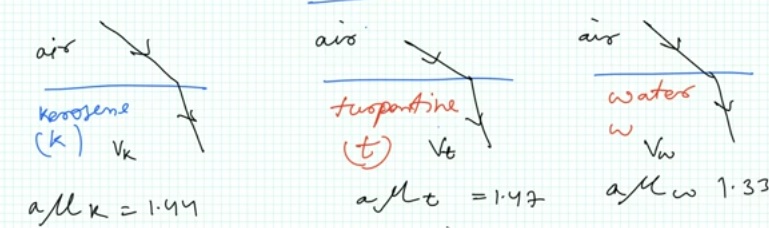
Solution: We know: R.I.= Speed of light in air / Speed of the light in the medium
Let
Speed of light in air=va
Speed of light in Kerosine = v k
Speed of light in Turpentine = v t
and Speed of light in Water = v w
Given :
v k = 1.44
v t = 1.47
and v w = 1.33
Therefore for kerosene we can write,
R. I. of kerosene (a μ k ) = v a / v k
or v k = v a / a μ k
∴ v k = v a / 1.44 – – – – – (1)
for turpentine we can write,
R. I. of kerosene (a μ t ) = v a / v t
v t = v a / a μ t
∴ v t = v a / 1.47 – – – – – (2)
for water we can write,
R. I. of kerosene (a μ w ) = v a / v w
v w = v a / a μ w
∴ v w = v a / 1.33 – – – – – (3)
All the three equation have v a as common numerator.
We also know that velocity of the medium is inversally proportional to R.I.
As the R.I. of water is lowest
therefore the velocity of the light will be highest in water. Ans.
Relation between Angle of Incident Emergent Angel Angle fo Deviation and Angle of Prism Physic
When a ray of light falls on a surface of a prism, it deviates from its original path and the ray of light is broken up into seven colours.
It is the constituent color of light. Due to this a spectrum is formed.
The individual colour that is visible in the spectrum , starting from bottom are : Violet, Indigo, Blue, Green, Orange and Red. This can be remembered with this letter ‘VIBGYOR’. Each letter is the starting letter of the color in the spectrum.
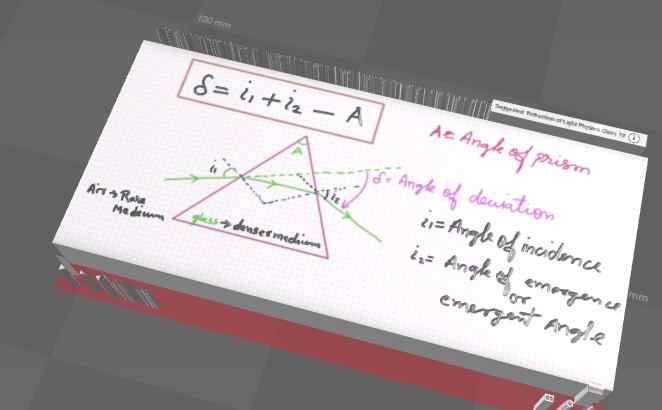
Here the relation between incident angle , angle of deviation and emergent angle has been shown. This relation is very important and it comes in the examination.
Watch the video carefully and comment if you have any query.
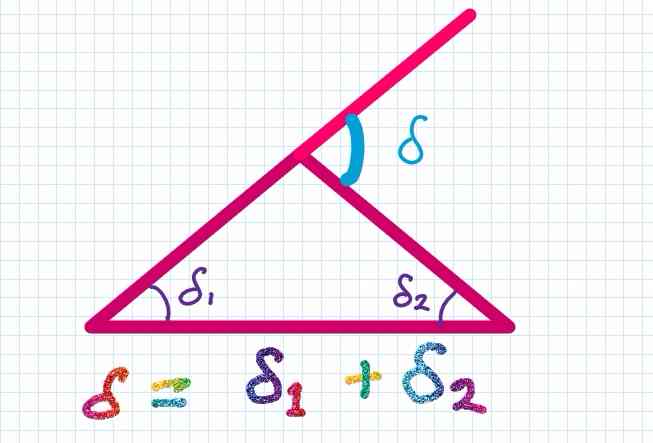
in Δ MPQ
∠LMQ =∠MPQ+∠PQM
OR ∂= ∂1+∂2 ——– (eqn 1)
Or ∂1 = i1 – r1
Or ∂2 = i2 – r2
In quadrilateral APNQ, We can write
We can write, ∠PNQ = 180- A ——– (eqn 2)( Because ∠APN = ∠AQN = 90)
But for ΔPNQ, we can write ,
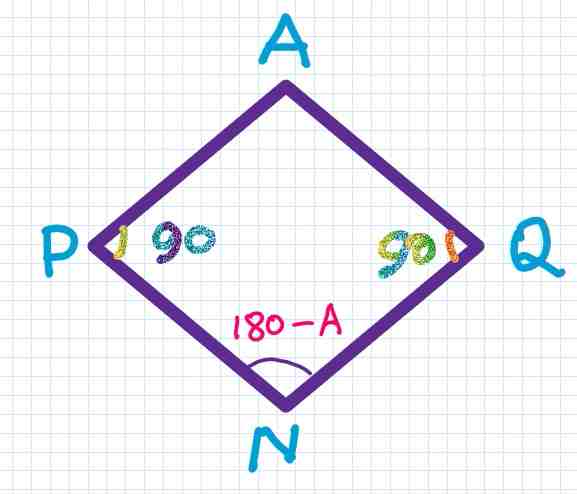
∠PNQ=180 – (r1+r2) ——– (eqn 3)
Comparing eqn 2 and eqn 3 we get:
180 – A = 180 – (r1+r2)
∴ A = r1+r2
Now we can write
∂1+∂2 = (i1 – r1 ) + (i2 – r2)
or ∂1+∂2 = (i1 + i2) – (r1+r2)
or ∂ = (i1 + i2) – A
Which is the reuired equantion.