
Significance of Title
Alice Walker’s Vision of Love, Nature, and Ancestry
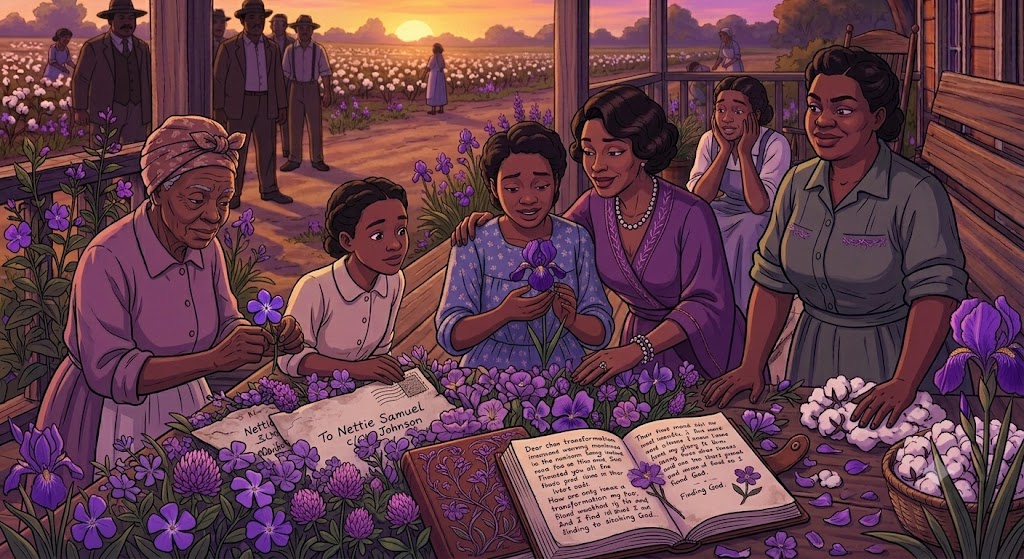
In an interview to Bill Moyers, Alice Walker tried to justify the title of her novel. She said that The Color Purple signified her love for her ancestors. The title, according to Walker, did not only conjure up an image of a field of sunflowers (called color purples) it is meant to symbolise her belief in love, the beauty of nature and the connectedness of people and nature everywhere. She believes that such a worldview is perhaps ‘very Buddhist’ and ‘very Hindu’ and ‘very farmer’ but growing up in Georgia her parents inculcated these values in her and to the present day she thinks that these beliefs are part of her Black legacy. Even as an artist and reformer Walker has always happened harped on the necessity to love, to forgive and to show compassion and understanding.
The Transformative Power of Love in The Color Purple
The Color Purple thus symbolizes the transformative force of love once an individual comes to believe in it. She tell Moyers, “The Color Purple came from the love of my grandparents… who were actually mean but were preserved in my parent’s memory as loving… I wanted to write so that people can see how you can transform as Celie is transformed.” Obviously, the source of such transformation is love.
Shug Avery and the Spiritual Meaning of the Color Purple
In the novel, the words The Color Purple are used by Shug when she speaks to Celie about appreciating God’s creation by paying attention to every detail for only then they would be able to appreciate life and transform themselves. In their conversation Shug tells Celie how she had a moment of epiphany when she realised that she was a ‘part of everything, not separate at all’. She no
longer felt like a ‘motherless child’. Shug goes on to say that ‘God loves every human emotion but most of all he loves admiration’. When Celie asks for a clarification of this statement Shug answers her in the following manner—’I think it pisses God off if you walk by the color purple in a field somewhere and don’t notice it.’ Celie realises that so far into her adult life she has never ever admired her surroundings. Thus her process of healing starts. She feels closer to everybody around her and can stand up to Mr._____ without fear. Also, she is transformed into a self-actualized character as she does not disintegrate when Shug leaves her. Instead she joins Harpo and Sofia in caring for their daughter Henriette.
Mr._____ and the Idea of Redemption
Mr._____ also goes through a transformation, although his moment of spiritual awakening is not recorded in the text. He tries to make amends for his behaviour towards Celie. He tells Celie: “But when you talk about love I don’t have to guess. I have love and I have been in love. And I thank God he let me gain understanding enough to know love can’t be halted just cause some peoples moan and groan.”
Universal Connectedness and Celie’s Final Transformation
Celie and Mr._____ both are transformed as they come to believe in love. Celie at the end of the novel thoroughly believes in the connectedness of everything, and therefore, along with God she addresses the stars, trees and ‘Everything’ in her last letter. Mr._____ also tells Celie that after believing in God’s love he has discovered the faculty of wonder. Now he wonders at God’s creation and this has made him all the more stable able to love and as a result people love him back.
Walker’s Womanist Vision and Black Community Healing
Walker writing in the 80s has tried solve the problem of the lack of understanding exists in the Black community, between Black men and women. Her womanist ethos and her commitment to the survival of the race as whole is complemented by her message in the belief in God’s love. She has been astute enough to diagnose that lack of love in the Black community is one of the reasons for uneasy alliance between men and women. She believes that if a ‘loving light’ was shone on them they would be more committed to the health of the community and become transformed as individual. Therefore, the title of the text The Color Purple is justified as it embodies Walker’s womanist message of love and understanding most successfully.
Importance of God and Religion in The Color Purple
The Role of God as Confidant in Celie’s Life
The Color Purple begins with the lines, “You better not never tell nobody but God. It’d kill your mammy.” The reader realises as he keeps on reading that it is Celie’s father’s injunction and he has specifically requested her not to talk about his incestuous exploitation of his daughter, except to God. Thus ‘God’ figures in the text as a confidant in whom Celie confides all her hopes and fears as she tries to make sense of her baffling experiences. Celie confesses everything to God but it is only midway into the novel that she realises God and explores the true meaning of being a believer in God’s grace.
Celie’s Early Image of a Eurocentric God
At specific points in the text Celie tries to describe God as she imagines Him. We realize that Celie’s perception of God is derived from images of an Eurocentric perception of a White God. She believes God to be an old man with white beard, blue eyes, wearing a white robe. When Sofia is jailed Celie thinks about God coming to save her. She envisages the following scene ‘… I think bout angels, God coming down by chariot, singing down real low and carrying s’ole Sofia home. I see ’em all as clear as day. Angels all in white, white hair and white eyes, look like albinos. God all white too, looking like some stout white man work at bank’. Celie stops believing in God when all certainties about her father and mother are destroyed.
Shug Avery and the Redefinition of God
It is Shug who resolves Celie’s crisis of faith by telling her about the real nature of God. Celie’s concept of God is shattered easily since she believed that He would rescue her from every situation. Celie tells Shug that God’s behaviour is like all the men she has known in her life—’Trifling, forgetful and lowdown’.
Shug’s concept of God is a pantheistic one and she tells Celie that one’s belief in God is consolidated (made stronger) when he/she felt connected to everything in the world and realised that God’s essence permeated every aspect of creation. Shug even goes as far as to compare the joy of the realisation of God’s love to erotic pleasure. God, according to Shug, wanted people to note the beauty of life and offer praise to Him if only to admire the beauty of a field of sunflowers. Celie is enlightened by Shug’s words and she starts to appreciate God’s creation.
Celie’s Final Spiritual Awakening and Connection with Everything
Finally, Celie resolves her differences with God and when Nettie returns from Africa with her children she addresses her letter—’Dear Everything, Dear God, dear stars, dear trees, dear sky, dear peoples. Dear Everything, Dear God’. She now feels the divine in every aspect of creation and thus addresses them all at the same time. Celie like Shug, now believes in God and feels connected with Him.