
Important aspects discussed are: Lights Out: Title/
Critical analysis of the crime/
Violence infiltrated on Women/
Female Consciousness and Male Chauvinism
LEELA: I know, I know. You’ve told me they’re not interested in cases like this, …but… but I’m frightened.
BHASKAR: Go tell the police that you are frightened about noises in the next building! They’ll laugh in your face!
Introduction to Light’s Out by Manjula Padmanabhan/Background and Real-Life Inspiration of the Play
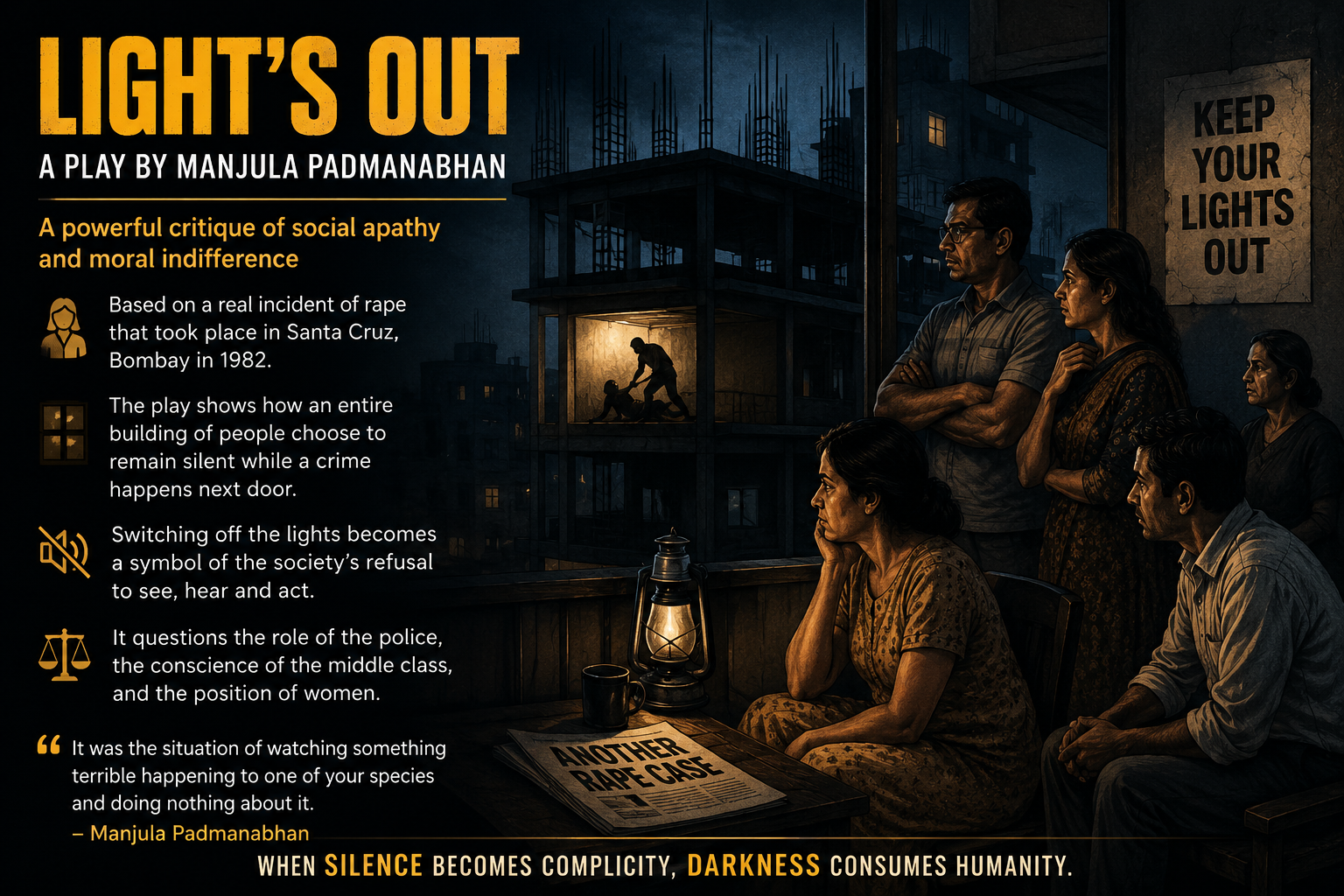
Manjula Padmanabhan’s Light’s Out is the repertoire of curiosity, frustration, claustrophobia and despondency at the milieu of humanity, society and conscience. The society’s most recurrent crime of ‘rape’ is incorporated in order to show the thick-skinned and dehumanised people who could not take any action. The play is inspired from a real life incident of rape which took place in Santa Cruz in the year 1982, in Bombay. Kavita, Manjula’s friend narrated this whole and recounted this horrendous event to Manjula. For Manjula confessed in an interview with Sharmila Joshi that “It was the situation of watching something terrible happening to one of your species and doing nothing about it.”
Summary of Light’s Out
Light’s Out is connected to the incident of rape as the rapists threatens the inhabitants of the nearby apartment to keep their lights out. The society has become so fragile that it is not able to take the necessary action for the victim. On the other hand, people have been compelled to put off their lights; mould themselves as if nothing occurs; indirectly becoming the act implied culprits in begetting the violence. If taken, metaphorically then ‘light’ stands for illumination, knowledge, logic, rationality and action. Whereas, the sophisticated, urban, literate class in the play is are under darkness. They attempt to become ignorant people and let the devils continue their monstrosity.
Leela, Bhaskar’s wife and the sensitive person, exhorts her husband to call the police. Bhaskar denies to do so because all the people in the adjacent and nearby apartments fear retaliation from the hooligans. They also lack confidence in police force. Indirectly, the’s middle class section does not want to engage in wiping out the evil. Comfort zone is their priority and Manjula turns the spotlight on the audience: ordinary, educated, upwardly-mobile, newspaper-reading, television-viewing citizens who already suspect that whether or not God is in his heaven, all’s not quite right with the world.
Lights Out exposes the so called human society, its foibles and vanity. The play is also Gulan Kripalani’s first play as director. She says that she was shocked to read the play and expressed “It can’t have happened!”. The fact which became perturbing was that the play is about people like us. It is realistic and relatable. Kripalani felt that something wrong had become to us because we have become inhuman beings. In the words of Kripalani ‘this dehumanisation must not go on’.
Social Apathy and Moral Indifference/
Violence Against Women and Silence of Society/
Fear, Powerlessness, and Urban Middle-Class Life
The play commences with Leela who is suffers from psychological trauma because of the screaming and gurgling sound from the adjacent building. Even though Leela seems to look concerned about the victim, but she is more concerned for herself than the woman. She contorts her face in despair, too, “Why should I be made to listen to the screams every night?”.
Bhaskar, Leela’s husband enters on the stage in a frivolous and unconcerned mood because he has managed to mould himself as an indifferent person towards the crime.
Mohan arrives on the scene as a guest, who was curious about the crime and weaves absurd theories. Beside when it becomes clear about the ghastly crime, he touts, “I don’t want to get involved. Besides, if the victim only screams and does not ask for help, how can we decent people interfere?”.
Naina, Leela’s friend examines the situation and confirms it is crime. Little hope comes in the audience when Surinder arrives. There’s hope still, for he is ready to rush out and “beat those bastards” right then. Unfortunately even the best of intentions don’t seem to survive faced with a lack of support and soon, Surinder too retorts to thinking of ridiculous solutions to what is happening outside.
The ghastly crime of ‘rape’ is the is employed to expose the thick-skinned society which has closed its eyes and shut its ears to the screams of the victim. Outside in the back lot of a newly constructed, unoccupied building, a bizarre incident of a incredible brutality was underway. And night after night, people watched it happen from their darkened windows, numb with shock and fear, but not moving to help the victim of the violence. T
hough reasons and justifications such as threats to the residents if they took action, or the so called practical difficulty in stopping a bunch of crazed beings were given, the fact remains that an entire locality of people, intent on not getting involved, let the crime be committed and instead, took measures such as switching off the lights, avoiding dinners at that hour or pretending to be deaf, just to avoid confronting the situation and themselves. The ongoing rape incident was the physical violence which has become a serious issue.
Character Analysis
Bhaskar – Rationalization and Indifference
But on the psychological plane, the violence is still persistent. Leela, Bhaskar’s wife could not tolerate the traumatic screams coming from the adjacent building. She exhorts Bhaskar continuously to call the police. Police is the representation of goodness and the force present to wipe out criminal acts. But the middle class family resorts to helplessness rather than action.
Leela – Emotional Awareness and Anxiety
Leela could have called the police on or her own but she does not do so. She can be taken as a dependent woman who needs her husband to call the police. On the other hand, it can also be interpreted as the subordinate position of the woman in a household. Bhaskar didn’t permit her to call the police. It seems that Leela needs empowerment to stand for the victim or else she is a weak character who is incapable of action as Bhaskar and others.
Naina and Surinder – Reaction vs Inaction
Naina is a sensible, rebellious and rational person. Even though she confirms that it is a rape, she is not that strong to take any action. When Surinder enters, he shows his typical masculinity who wants to thwart the monsters. But his attitude towards Naina reveals Surinder to be a person bearing patriarchy. He scolds Naina horribly. Naina could emerge as a strong character but she also resorts to serfdom instead of questioning.
Frieda – Silence as Resistance
Next Frieda is a different sort of woman, who remains silent throughout the play. Her activities and works show she is a more sensible person than others. She knows what to do and when. Her silence is one type of weapon. She does not expect anything from this coward patriarchal society. and accepts to remain silent and persistently continues her work. She is independent where in comparison to Leela and Naina who are dependent on their husband for any action. Her silence speaks a lot of our society. The status of society who could give dictate a woman’s life but could not protect her. The silence is a weapon which compels others to become shows mirror to this so called good middle class people. The silence represents the silence of all those unempowered women who requires strength & support.
Symbolism in Light’s Out/Role of Police and Institutional Failure
The important question also arises that why is this middle class people weak to take any action. Its responsibility directly goes to the system that is accountable for maintaining the stability of the society. The agency, which should have generated confidence in people, inspire the insecurity in them. People do not trust the benevolence of the police. There is a bleak implication in the play that police would compound any problem, instead of resolving it. If the image of that agency which is responsible for maintaining law and order in the society is so unhealthy, how can we expect the body of the society to be a healthy one?
Conclusion
Light’s Out is a powerful social drama that exposes the moral failure, fear, and indifference of the urban middle-class society in the face of violence against women. Through the horrifying incident of rape and the passive reactions of the characters, Manjula Padmanabhan highlights how silence and inaction can make ordinary people complicit in injustice. The play not only critiques patriarchal attitudes and social apathy but also questions the effectiveness of institutions responsible for maintaining law and order. By portraying characters who choose comfort and self-preservation over responsibility, Padmanabhan compels readers and audiences to reflect on their own ethical obligations. Ultimately, Light’s Out serves as a disturbing yet important reminder that social change is possible only when individuals overcome fear and take a stand against injustice.