
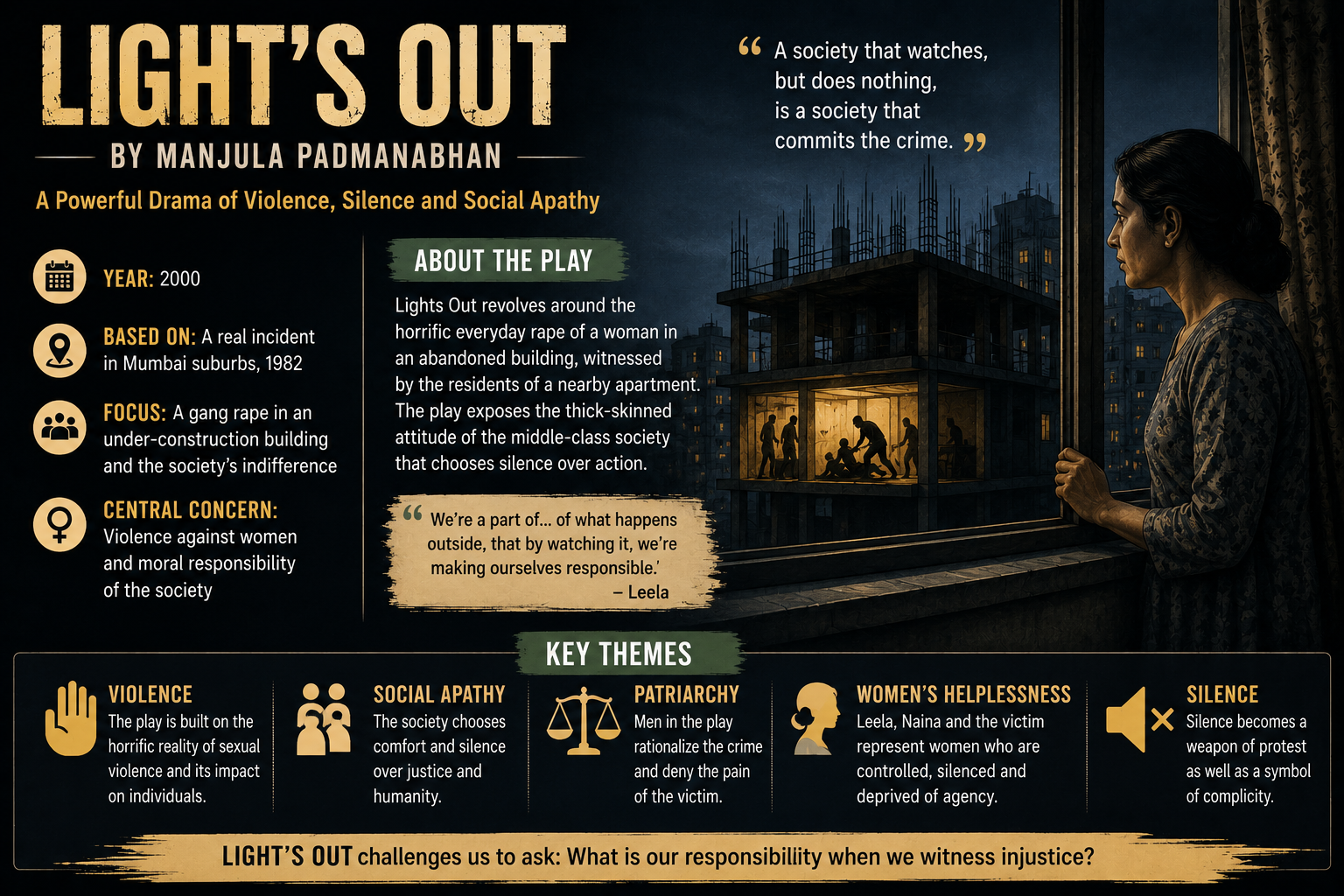
Light’s Out by Manjula Padmanabhan is a powerful critique of social apathy, patriarchal attitudes, and moral irresponsibility. Through characters like Leela, Bhaskar, and Naina, the play explores empathy, gender inequality, and society’s failure to act against violence.
Introduction
Lights Out (2000) by Manjula Padmanabhan is a gut-wrenching play based on a true incident of rape that occurred around the suburbs of Mumbai during 1982. The play does not only show the violation of a female but also the ruthless society which is least interested to take any action. However, during the course of the play, Leela is the character who is depressed due to the incident. She is bewildered by her husband’s rationale heartless rationality. She could feel the pains of a helpless woman, being a woman herself. The play challenges the entire social structure, people’s responsibilities, and their psyche in a very humiliating situation.
Real-Life Background of the Play
The play though not particularly but specifically addresses the miserable plight of women in India and the way men look at them as secondary human being. All the three women, Leela, Frieda and victim are shown passive. They are exploited either physically or mentally in the society or in their own houses by their family members. This tragic incident of rape is witnessed at a distance by the middle class characters who are divided on their opinions of either to inform the police or not. The most depressing fact is that the society does not interfere or show their awareness for the heinous incident.
Social Apathy and Human Responsibility
The play is set in an urban socio-cultural patriarchal society in India. It opens with a young middle class couple Bhaskar and Leela.
Leela as the Voice of Social Conscience|Leela’s Empathy for the Victim
They are living best in an apartment beside a building which is under construction. Leela is seen as anxious, in an uneasy demeanour & she constantly implores Bhaskar to call the police. Bhaskar is a carefree person who is happy in his daily routine. Actually, he is an irresponsible and inhuman person. The rape takes place everyday in the building under construction in open. The neighbourhood is content in their daily lifestyle and has become thick-skinned heinous does not pay any heed to the incident taking place every day.
Psychological Trauma and Anxiety
What is important is the difference between Leela and Bhaskar. Leela is a sensitive human being. She could empathize with the victim as a woman. She says a very important thing that “we’re a part of… of what happens outside, that by watching it, we’re making ourselves responsible.” Leela is suffering from distress and anxiety due to the incidents & she expects Bhaskar to help her in this case. She requests him to call the police.
But she never calls the police herself which show that dominan her that she does not have the right to take any action herself. Bhaskar takes the incident casually. He does not react in a humanistic manner but and makes a very strange excuse, “In that case the police have obviously ignored their claims!”. He prioritizes his works and thinks rape to be a simple offence, which is horrible.
Bhaskar and the Patriarchal Mindset
The importance lies in the reaction of every character as well as the society to the heinous activity. The degree of action and awareness show how much humanity is instilled in us.
The scene II introduces Mohan in the play. Mohan is curious about the rape. He asks Bhaskar about its commencement. Mohan instigates anger within the audience. He calls the heinous act as religious exorcism. Both Bhaskar and Mohan take time to engage in calculating about the incident whether it is a rape or not. But both of them are coward, irrational and inhuman to take any action. Unlike Leela, Mohan and Bhaskar could not identify themselves with screaming of the raped victim. They even ridicule Leela’s over-sensitiveness and blame as purposeless.
Indifference Towards Violence
Here, it is not an issue of private life and the public life. Beena Agarwal in her article “Manjula Padmanabhan’s Lights Out: A Credo of Social Empathy and Human Predicament” opines that,
Private life and public life require different levels of commitment but Padmanabhan through the personal crisis of characters in Lights Out admits that private spaces of personal life are closely integrated with the public life and it is the harmony of the two that can ensure the balance in society.
The victim is tortured even in the third act. New characters join the home of Leela and Bhaskar. Leela is almost sick of the incident. Naina implores for a quick and daring action. But Mohan and Bhaskar are surprisingly indifferent.
Mohan and Society’s Passive Response
Bhaskar’s remarks are very derogatory. He calls says that “she could be a whore you know… a decent woman would never be with four men at once.” Naina raises a very important claim here. She defends the rights of prostitutes that “even a whore has the right to choose her clients”. Leela and Naina raise the issue of equality and dignity of the woman who is a victim of the male dominance and exploitation.
Marxist Perspective on Light’s Out
The struggle is evident between the genders with an oppressive social order or conflict for existence. This oppressive system can be studied from the Marxist and psychological perspectives too.
Marxist literary criticism views people as products of circumstances and social upbringing. So, as circumstances, people also change. But we neglect the truth that circumstances can also be changed by people. It is worthless to identify the class or caste of a gang rape victim.
Conclusion
But more importantly she is a woman who has been physically harassed. It reflects upon the poor plight of a woman irrespective of change in time or age. The patriarchal system has motivated women to fight for the social equality. This struggle against inequality is at the centre of Marxism and studies the power structure or relationship between the proletarian & bourgeois or hierarchy between genders.