India Solutions |ICSE|CBSE|Other Boards

India-Size and Location Important Questions and Answers MCQs 1. Which latitude passes through the middle of India? A. Equator B. Tropic of Capricorn C. Tropic of Cancer D. Arctic Circle Answer: Tropic of Cancer 2. What is the Standard Meridian of India? A. 90°E B. 82°30′E C. 75°E D. 68°E Answer: 82°30′E 3. Which water … Read more
Minerals and Energy Resources Solutions|ICSE|CBSE|Other Boards

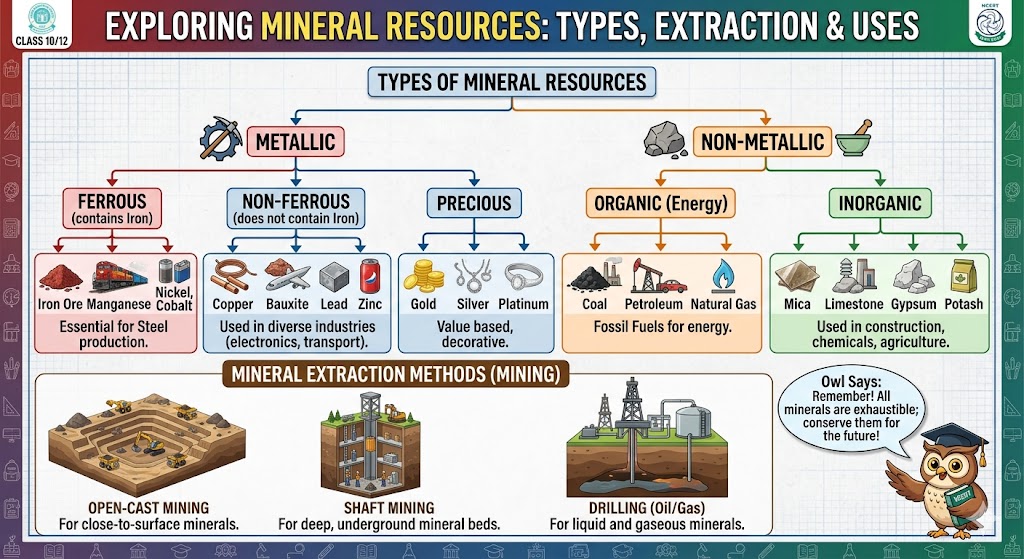
A detailed flowchart and illustration set for CBSE Class 10/12. It classifies minerals into Metallic (Ferrous, Non-Ferrous, Precious) and Non-Metallic (Organic, Inorganic) groups, describes mining methods like Open-cast and Shaft mining, and includes a conservation tip from an owl mascot.

Important Questions and Answers Very Short Answer Questions (1 Mark) Q1. Define mineral. A mineral is a naturally occurring substance with definite chemical composition. Q2. Name two non-conventional energy resources. Solar energy and wind energy. Short Answer Questions (3 Marks) Q1. Differentiate between ferrous and non-ferrous minerals. Ferrous Minerals Non-Ferrous Minerals Contain iron Do not … Read more

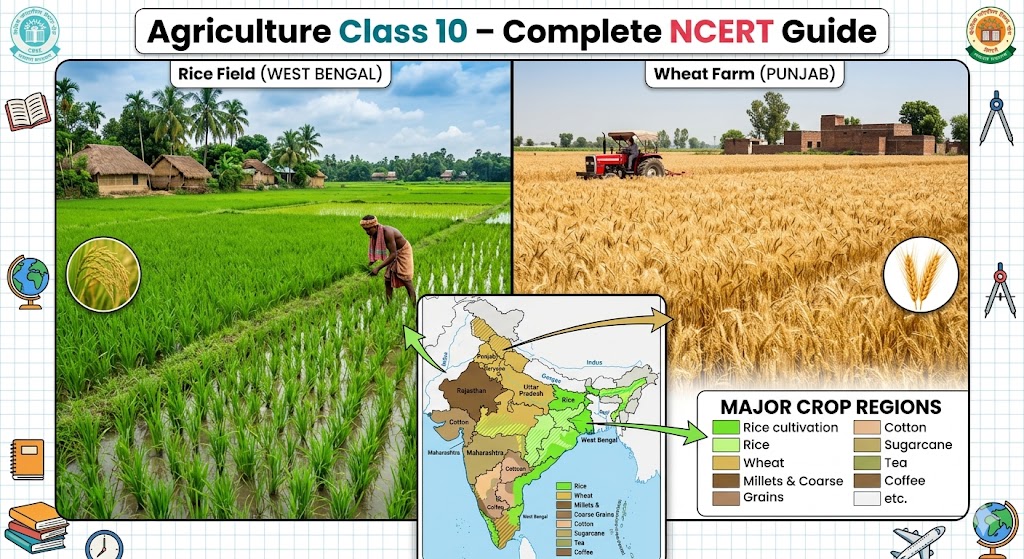
Agriculture Solutions Class 10|ICSE|CBSE|Other Boards

A split-screen infographic showing a lush green rice field in West Bengal on the left and a golden wheat farm with a tractor in Punjab on the right. An India map at the bottom displays major crop regions like rice, wheat, cotton, and tea.

Important Questions ✅ Very Short Answer (1 Mark) Q1. What is Sericulture? Ans: The rearing of silkworms for the production of silk fiber. Q2. Name the crop known as ‘Golden Fiber’. Ans: Jute. Q3. What is Jhumming? Ans: Shifting cultivation practiced in Assam, Meghalaya, Mizoram, Nagaland. Q4. Define Bhoodan movement. Ans: Land donation movement initiated … Read more

Water Resources Solutions Class 10|ICSE|CBSE|Other Boards

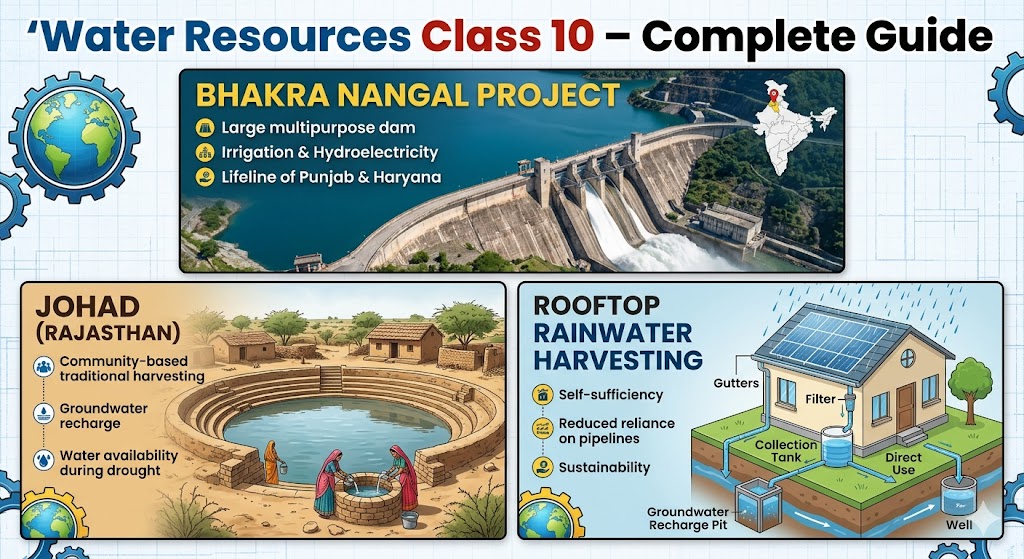
An educational infographic collage titled "Water Resources Class 10 – Complete Guide." It features a photo of the Bhakra Nangal Dam, an illustration of a Rajasthani Johad, and a technical diagram of rooftop rainwater harvesting, each with bulleted key points.

Important Questions ✅ Very Short Answer (1 Mark) Q1. What is water scarcity? Ans: Shortage of usable water due to high demand, pollution or unequal distribution. Q2. Define rainwater harvesting. Ans: Collection and storage of rainwater for future use or groundwater recharge. Q3. Name one multipurpose project on river Sutlej. Ans: Bhakra Nangam Dam. Q4. … Read more

Latitude and Longitude Solutions|ICSE|CBSE|NCERT|Other Boards

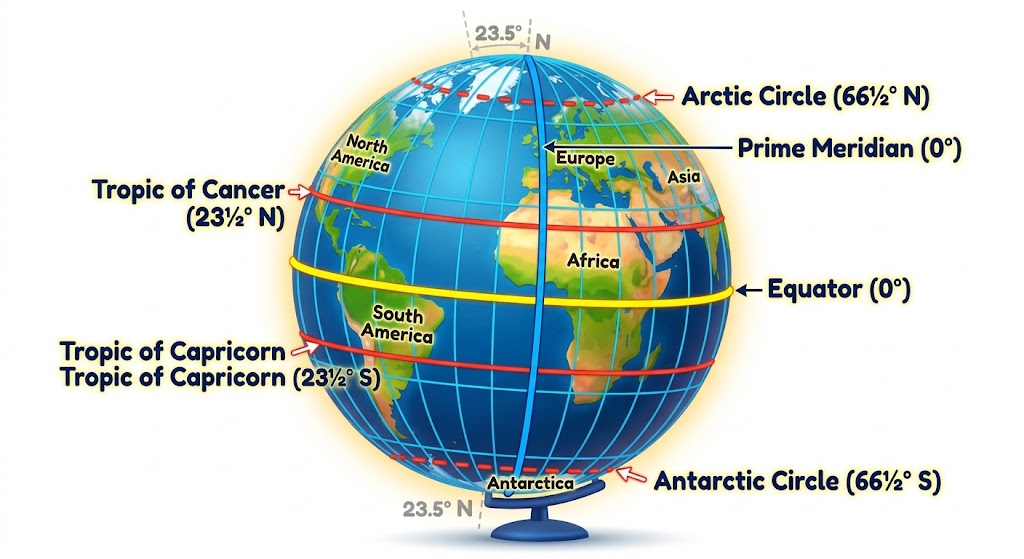
A colorful 3D educational illustration of the Earth on a stand, featuring a grid of red horizontal latitude lines and blue vertical longitude lines. The Equator is highlighted with a thick yellow line, and major parallels like the Tropics and Arctic/Antarctic circles are clearly labeled with their degrees.

  📝 Most Important Board Questions for 2027 (ICSE Pattern) Multiple Choice Questions (MCQs) Q1: The Prime Meridian passes through which city?Answer: (c) Greenwich Q2: The Earth rotates through how many degrees of longitude in one hour?Answer: (b) 15° Q3: Which longitude is also known as the Anti-meridian?Answer: (c) 180° Q4: The difference between two … Read more

Industrial Revolution Solutions|ICSE|CBSE|NCERT|Other Boards

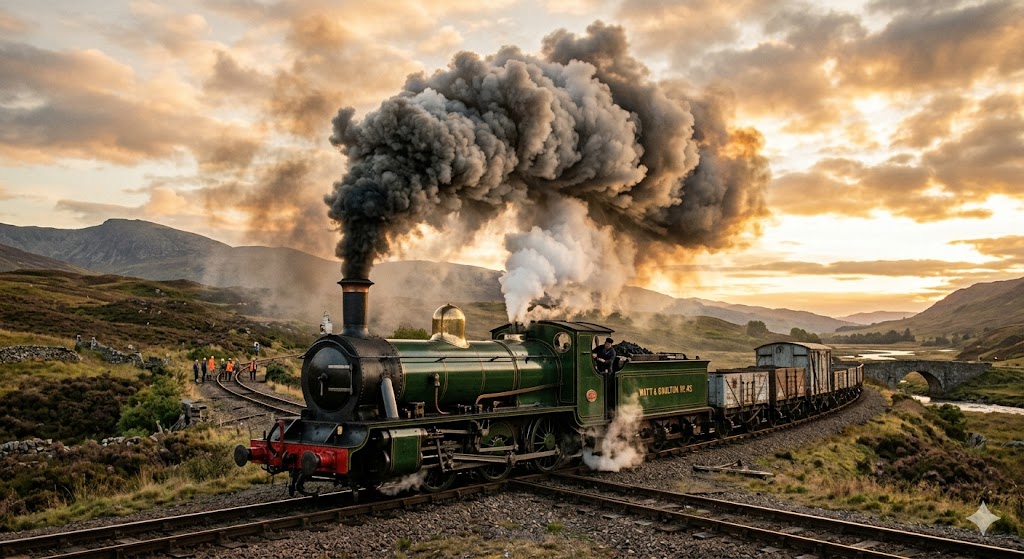
ndustrial Revolution ICSE Class 9 causes capitalism socialism steam engine factories

Introduction Steam whistles piercing smoky skies, factories humming 24/7, children laboring looms – welcome to the Industrial Revolution ICSE Class 9, the game-changer that birthed modern world! Starting Britain 1760-1840, it swapped handcrafts for machines. Why must-master? High-scoring chapter (15-20 marks), questions on causes, capitalism/socialism. Links Modern Europe. Nail unit tests, prelims, boards – understand … Read more

The Reformation Solutions|ICSE|CBSE|NCERT|Other Boards

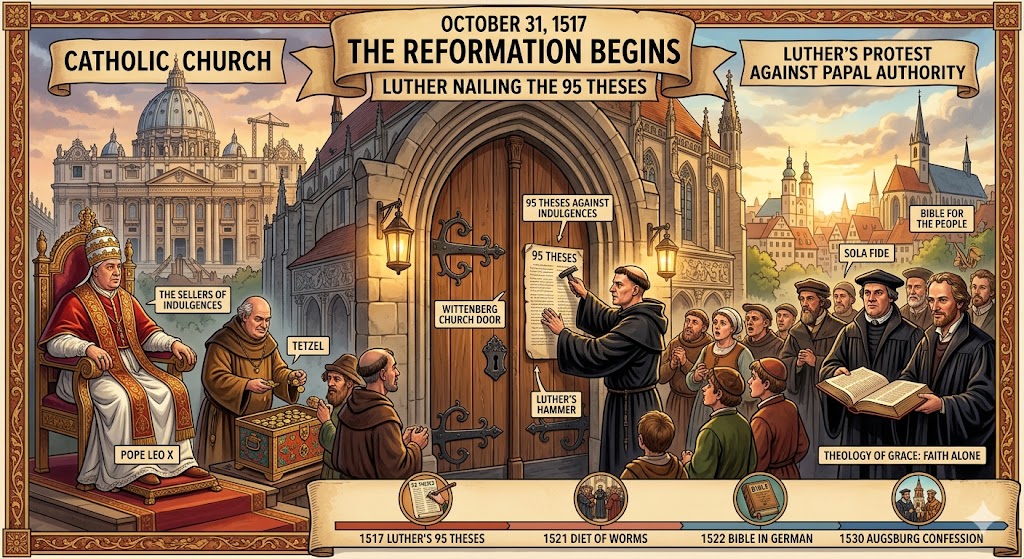
The Reformation Class 9 ICSE History illustration showing Martin Luther and the 95 Theses

The Reformation: Complete ICSE Class 9 History Study Guide (Notes, Q&A, MCQs) Introduction Imagine living in 16th-century Europe, where the most powerful institution in the world — the Catholic Church — controlled not just religion, but politics, education, and the economy. Now imagine a single monk, armed with nothing but a hammer, some nails, and … Read more

You cannot copy content of this page